How to Load and Unload a Truck Camper: Jacks, Tie-Downs, and Storage
November 13, 2026
Whether it comes off every weekend or once a winter, here’s how to get a truck camper off and back on without bending a jack, a bed rail, or a weekend.
An Alaskan comes off the truck for winter storage, a trip to the body shop, a new truck, or a season when the bed has other work to do. Give yourself time, especially for the first few attempts. The steps below follow Rieco-Titan’s jack instructions, Torklift’s tie-down guidance, and the Alaskan operations manual.
At Loadout Day, we install frame-mounted tie-downs if they’re part of your order, mount the camper on your truck, and show you how to take it off. This guide covers the same steps, so you have them on hand when you do it yourself.
Before anything moves: Never get under a raised camper, and don’t let anyone else under it. Keep kids and pets well clear. Rieco-Titan’s instructions say never let anyone stay inside the camper while it’s being loaded or unloaded~~, and to stay in full view of the jacks while they’re moving. Keep the jacks being operated in view. This guide gives the general sequence. Your jack and tie-down manufacturers’ instructions and the Alaskan operations manual come first, and if you’re unsure about anything on your setup, call us at 360-767-9271 before you start.
The numbers at a glance
| What | Number |
| Tie-down tension, Torklift FastGun turnbuckles | 300 lb per corner |
| FastGun O-ring gap at 300 lb | About 1/4 inch, after setting the indicator as instructed below |
| Jack lift per round | 3 to 4 inches, front first |
| Clearance before moving the truck | About 6 inches above the bed |
| Slide-in Alaskan wet weight | 1,900 to 2,800 lb, before gear |
Tie-downs and turnbuckles
Alaskan installs frame-mounted tie-downs only. About 70% of owners have them put on at Loadout Day, which takes about an hour and a half to two hours, depending on the truck. Flatbed Alaskans use bolt-down mounting to the flatbed platform instead of the slide-in tie-down arrangement. If you want the setup locked, the FastGun pins can be swapped for Torklift’s lock system.
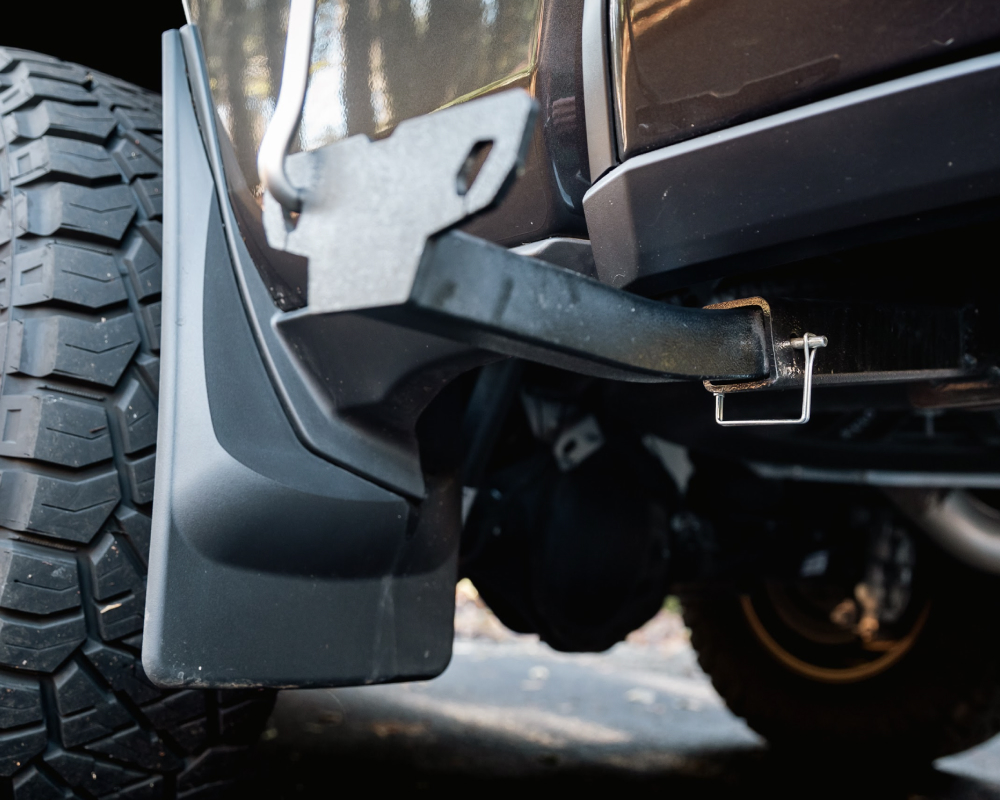
Alaskan offers Torklift FastGun spring-loaded turnbuckles. Their internal springs allow some movement over uneven roads, helping reduce stress on the camper’s anchor points.
Tie-down placement and turnbuckle angles must follow the instructions for your truck and mounting system. Torklift recommends a slight downward angle from the camper anchor to the tie-down.
How tight should truck camper tie-downs be?
For the Torklift FastGun turnbuckles Alaskan installs, Torklift’s spec is 300 lb of tension at each corner. That sounds like a lot until you remember what it’s holding.
You don’t need a gauge. Each FastGun has an O-ring indicator, and when the O-ring sits about a quarter inch from the end, you’re at 300 lb. Tighten to the indicator and stop there.
To adjust one, pull the pin, lift the FastGun handle, and twist: righty-tighty, lefty-loosey. Here’s the whole process in under a minute.
If you run a different turnbuckle system, use that manufacturer’s tension spec. The 300 lb figure belongs to the FastGun.
Torklift doesn’t publish a recheck interval, so make it a habit: glance at the indicators at fuel stops and after any washboard you’d rather forget.
Truck camper jacks
Every Alaskan comes with jack plates at the corners. The jacks are an option: Rieco-Titan Removable Jacks with Vertical Extensions, listed in the buyer’s guide. Slide-ins on dually trucks use a jack extension box, and flatbed models use corner extension brackets and corner mounts so the jacks clear the deck. If your camper wears another brand of jack, follow that manufacturer’s manual over the steps here.
Before you lift, check your jack set’s rated capacity against what your camper weighs loaded. Alaskan lists slide-in wet weights of 1,900 to 2,800 lb, and gear, food, and water add to that. To know for sure, weigh your camper and read the scale ticket.
Jacks are for loading, and a terrible place to spend the winter. Rieco-Titan advises against camping in a camper standing on its jacks, because dismounted campers get wobbly, and says to keep a camper as low to the ground as possible if you unload it mid-trip. Our operations manual adds that leaving a camper on its jacks for long stretches can bow the floor and midsection.
Before you start
- Find level, firm ground. Rieco-Titan says to load, unload, and store only on level ground, with each base pad on solid footing so it can’t tip or sink.
- Check the wind. Rieco-Titan says not to load on a windy day, and how much is too much depends on your exposure and the camper’s weight. A raised camper is a tall, tippy target.
- Clear ice from the footpads. In freezing weather, clear ice from the jack footpads before you lift.
- Empty the camper of people and pets, and secure loose gear inside.
- Bring a spotter. You can watch one side of the camper. Only a spotter can yell “stop” about the other.
How to unload a truck camper
- Disconnect everything. Release all four tie-downs (pull the pin, lift the FastGun handle, and unhook) and unplug the 7-pin connector on the camper’s front wall, which carries 12V from the truck. Walk around once more and confirm nothing still connects camper to truck.
- Set the jacks. Extend each jack until its pad sits flat on solid ground.
- Raise the front first. Lift the front 3 to 4 inches, then bring the rear up until it’s level with the front. Never let the rear sit higher than the front.
- Repeat in rounds until the camper is about 6 inches above the bed and clear of the bed rails and wheel wells.
- Drive out slowly. Pull straight forward with your spotter watching the gap between the jacks, fenders, and wheel wells.
- Lower it. Bring the rear down first, 3 to 4 inches at a time, then the front, keeping the front at or above the rear. Set the camper on its storage platform (below) or as low as it will go.
How to load a truck camper
- Raise the camper so its floor clears the bed rails by a few inches, front first, keeping the front at or above the rear.
- Back in slowly and straight. Your spotter watches the jacks and the gap on both sides.
- Stop in position, centered side to side and seated where it rides normally.
- Lower in rounds, rear first, 3 to 4 inches at a time, until the camper’s weight is on the bed. Never let the rear sit higher than the front.
- Retract or remove the jacks.
- Reconnect. Tighten each FastGun to its indicator, plug in the 7-pin connector, and check the camper’s lights before you drive.
Where the camper lives off the truck
Support the whole floor. Our Loadout Day guide recommends heavy-duty sawhorses topped with a full-width plywood platform, or a custom pallet. Propping a camper up at the corners only puts stress on the two-piece frame and the full rear door. Set it on level ground, out of the wind if you can.
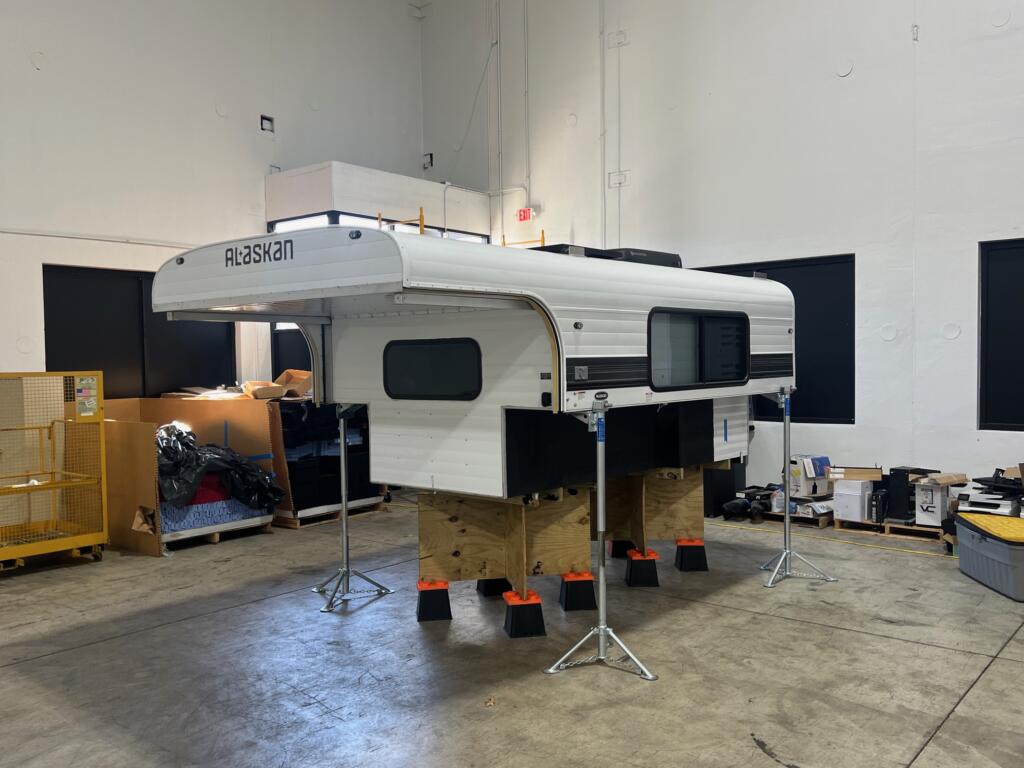
We’re developing a standardized storage solution. In the meantime, ask us for DIY platform plans.
For winter, pair this with our guide to winterizing your Alaskan.
Flatbed Alaskans
Flatbed Alaskans use bolt-down mounting rather than the slide-in tie-down arrangement described above. Before removal, confirm the mounting-bolt locations, jack setup, and unloading procedure with Alaskan. All mounting hardware securing the camper to the platform must be released before lifting. Follow the specified hardware and torque requirements when reinstalling.

Common mistakes
- Raising the rear higher than the front.
- Pulling away with a tie-down or the 7-pin plug still connected.
- Leaving the camper on its jacks for a season.
- Supporting the camper at the corners only.
- Unloading on soft ground or on a windy afternoon.
- Tightening past the turnbuckle indicator.
Frequently asked questions
How tight should truck camper tie-downs be?
For Torklift FastGun spring-loaded turnbuckles, 300 lb per corner, which shows as about a 1/4-inch gap at the O-ring indicator. Other systems have their own specs.
Can I stay in my truck camper while it’s on jacks?
Rieco-Titan advises against it. A camper standing on its jacks is unstable, and nobody should be inside while it’s being raised or lowered.
How high do I lift the camper to drive the truck out?
About 6 inches above the bed, and high enough to clear the bed rails and wheel wells.
Can one person load a truck camper?
Use a spotter. One person can’t watch both sides of the camper and the jacks at once.
How should I store a truck camper off the truck?
On level ground, with the whole floor supported by a full-width platform. Corner-only support stresses the frame.
Do Alaskan Campers come with jacks?
Jack plates are standard. Rieco-Titan removable jacks are an option.
Related reading