The Electric Experiment: A 1973 Alaskan Built to Charge a Lightning
A 2023 Ford F-150 Lightning XLT hauling a 1973 Alaskan isn’t supposed to work. Strap a hot tub on a trailer behind it, and most people would call the whole thing a bad idea. Matt Mortensen built the real thing and drives it into places where even gas rigs hesitate.
He started with the problem every EV owner eventually hits: range loss comes from weight and wind, but wind is the one that really punishes speed. The Alaskan’s low profile meant he wasn’t pushing a brick through the air, giving him a better baseline than most campers. From there, he rebuilt the rear and front structures, kept all the seventies charm and engineered an insulated subfloor hiding a deployable solar array that can feed energy back into the truck.
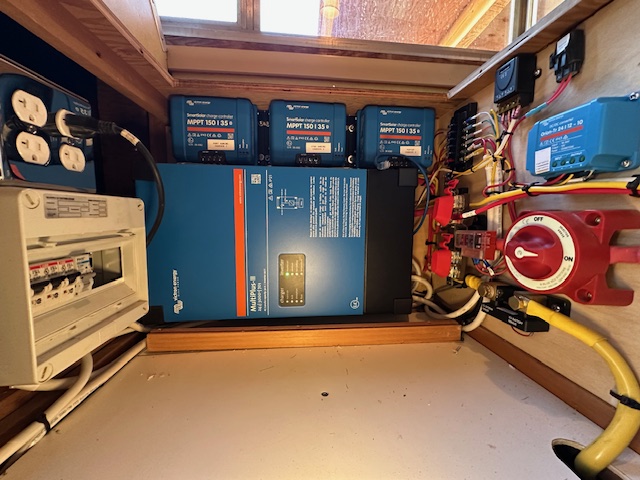
The setup pushes 2.5–3.0 kW of solar into a 7.2 kWh battery—enough on the right day to give the Lightning about 25 miles of range without relying on shore power or any backup. Just a fifty-year-old hard-sided pop-up quietly feeding the truck that’s hauling it.
It’s the same mindset behind ReVision Marine, the company Matt co-founded to replace outdated marine systems with clean, efficient, renewable power. He took that mindset from boats to backroads and built a camper-and-EV combo that performs well outside the boundaries most people imagine.

Meet Matt
Matt Mortensen has been working in marine electrical design and installation since the late 90’s, long enough to see exactly how older onboard systems waste energy and limit what a vessel can actually do off-grid. In 2014, he co-founded ReVision Marine to push those systems forward. The shop focuses on modern, efficient electrical design for recreational and commercial boats—everything from better battery architecture to cleaner, quieter power setups and full electric-propulsion projects when the use case calls for it.
That background shapes how Matt approaches any off-grid rig. When he turned to campers, he saw the same weaknesses he’d been solving on the water: inefficient power flow, fossil-fuel-dependent systems, and designs that worked against the vehicle instead of with it. The 1973 Alaskan was his chance to fix all of that. Keep the charm, rebuild the systems underneath, and make the whole platform far more capable. The result isn’t a science experiment. It’s the same practical, efficiency-driven mindset he uses at ReVision—just applied to a camper riding on a Lightning.
Building the Rig
Most people shim a camper in a truck bed by tossing a few 4x4s in the bed and calling it good. Matt did that for a while, then tore it all out and built a foundation that actually matched the truck. He constructed an insulated subfloor using 1¼ inches of foam, installed an electric in-floor heat mat, and incorporated fork pockets so he can lift the camper with a forklift. The new platform sets the Alaskan at the right height above the Lightning’s cab and creates protected space for storing his solar panels and wiring.
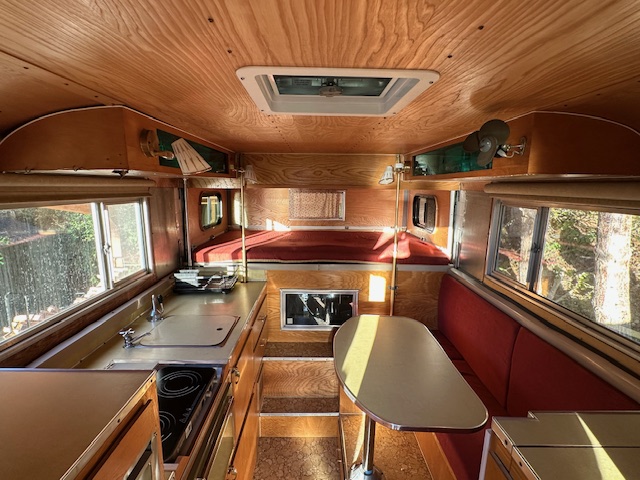
From there, he rebuilt the rear structure and restored the front, but he didn’t touch what made the camper worth saving. He kept the good stuff: yellow counters, aqua-green doors, real wood walls. The personality stayed front and center while the new systems disappeared into the background. The induction cooktop hides behind the vintage Camp Chef stove face, and the new refrigerator still wears its original green door. It feels like 1973 until you turn anything on.
The solar system is where the old-meets-new part gets wild. Matt stores the panels under the camper, then slides them out onto curtain-track awnings when parked. With about 1,000 watts on the roof, roughly 550 watts per side awning, and a 400-watt windshield blanket, total output lands between 2.5 and 3.0 kW. All of it feeds a 7.2 kWh onboard battery managed by a Victron inverter—enough to power the camper, supplement the Lightning through Pro Power Onboard, or send miles back into the truck on a good day. Nothing about it behaves like a fifty-year-old camper. And that’s the point.
The Big Sur Run
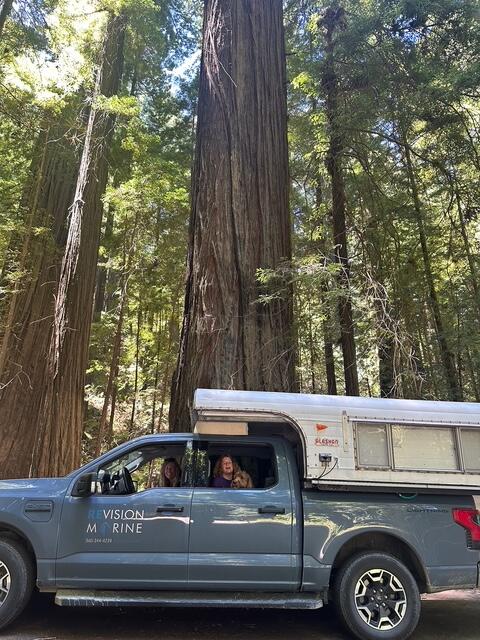
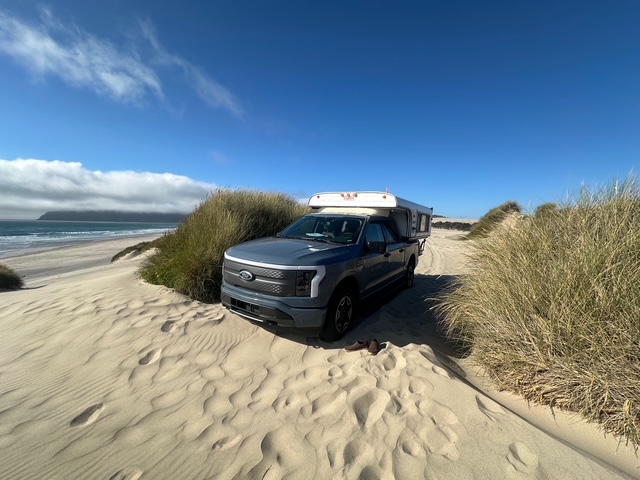
The first major test was a 3,125-mile loop from Port Townsend to Big Sur and back. Speeds on Highway 101 and Highway 1 rarely top 55 mph, which helps range, but hauling a 1,560-pound cabover still punishes efficiency. Matt, his family, and their dogs dry-camped for two to three nights at a time, then plugged into 30–50 amp RV service for a night to refill the truck and run cabin loads.
The surprise wasn’t the comfort—it was the numbers. The rig averaged 1.6 mi/kWh, and the camper’s electrical needs only consumed about 7 percent of the Lightning’s total battery over the month. His fast-charging bill came to $616.48, roughly half of what the same trip would cost in fuel for a gas F-150 hauling an Alaskan.
- Distance: 3,125 miles
- Efficiency: 1.6 mi/kWh
- Charging Cost: $616.48 in total fast charging
- Camper Load Impact: ~7% of total truck battery over the entire month
- Travel Pattern: 2–3 nights dry camping, followed by RV park stays using 30–50A service
- Why it’s impressive: A month-long mixed-terrain trip with a cabover, family, dogs, and gear—still cheaper than gas by nearly half.
The Magruder Corridor
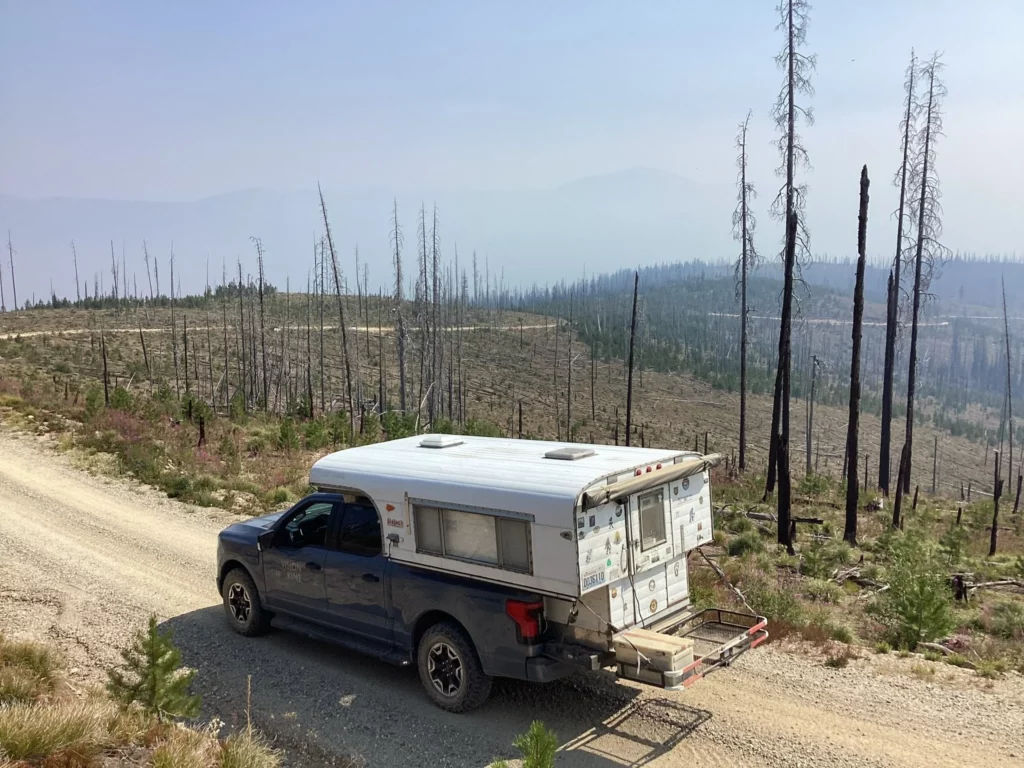
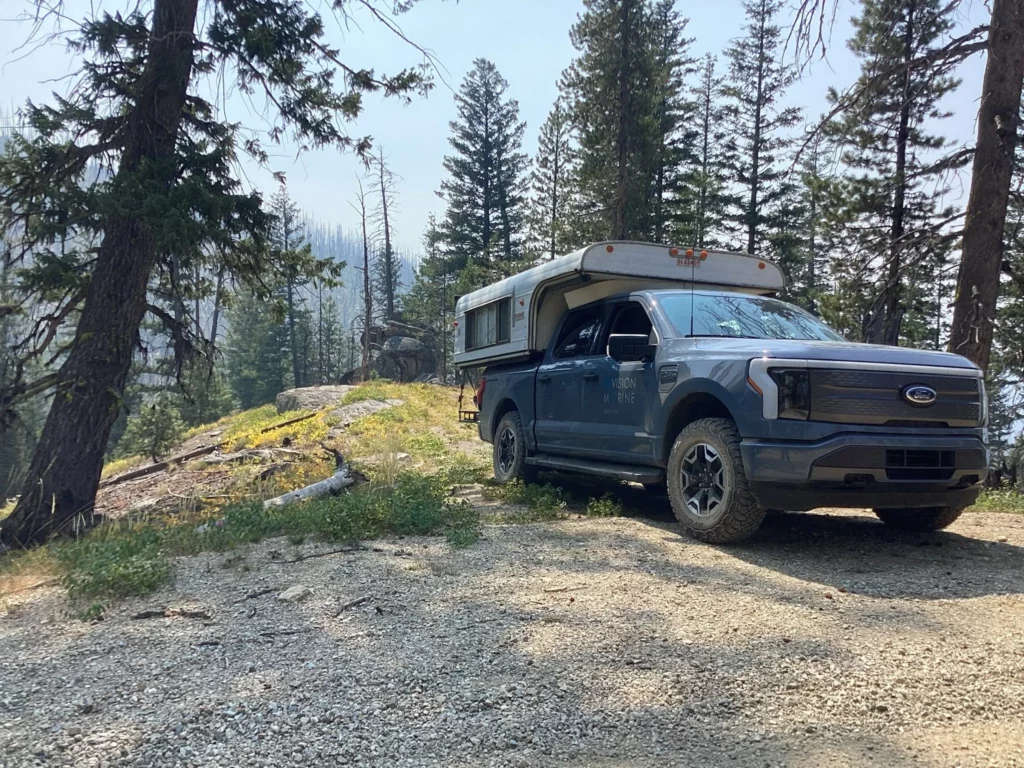
Next came the route most EV skeptics use as a punchline: the Magruder Corridor, the longest uninterrupted dirt road in the lower 48. It’s a 113-mile stretch of rugged track with roughly 12,000 feet of total climbing, multiple passes over 7,000 feet, and no pavement the entire way. The real challenge isn’t just the dirt miles, though—it’s the full ~145-mile gap between Elk City, Idaho and Hamilton, Montana, with zero charging options anywhere along the route.
Matt ran it in a standard-range Lightning on KO3s, hauling the fully loaded 8-foot Alaskan with passengers, dogs, water, and gear. After charging overnight near Elk City, he climbed into the corridor, dropped into the Selway River valley to camp, then climbed back out through wildfire smoke and over Nez Perce Pass. He rolled into Hamilton with about 10 percent battery remaining, averaging 1.5 mi/kWh across the hardest terrain of the entire build. People deep in the backcountry couldn’t believe a Lightning made it that far from pavement.
- Distance: 113 miles of dirt
- Elevation: ~12,000 ft of total climbing over multiple 7,000+ ft passes
- Remoteness: 70–100 miles to pavement or power in any direction
- Efficiency: 1.5 mi/kWh
- Battery on Arrival: ~10% remaining in Hamilton, MT
- Why it’s impressive: The most remote road in the lower 48, completed in a standard-range Lightning on KO3s with a loaded 8′ Alaskan.
The Olympic National Forest Winter Trial
Matt also wanted to see how the setup handled real cold, so he ran a 129.8-mile loop through the Olympic National Forest with temps around 35°F and dipping to 30°F at night. The route climbed multiple 3,500-foot passes and stacked up about 10,000 feet of elevation gain. Inside the Alaskan, they cooked on induction, heated water electrically, ran lights and refrigeration, and kept the cabin warm with the heat pump. Even with the cold-weather penalty, the Lightning finished the loop at 1.4 mi/kWh with 9 percent battery remaining, giving Matt a solid baseline for winter performance.
- Distance: 129.8 miles
- Elevation: ~10,000 ft of total climbing
- Temperature: 30–35°F with rain and snow
- Efficiency: 1.4 mi/kWh
- Battery on Arrival: 9% remaining
- Why it’s impressive: Full cabin comfort (heat pump, induction cooking, refrigeration, lighting) in sub-freezing weather with minimal climate penalties.
Living With the Rig
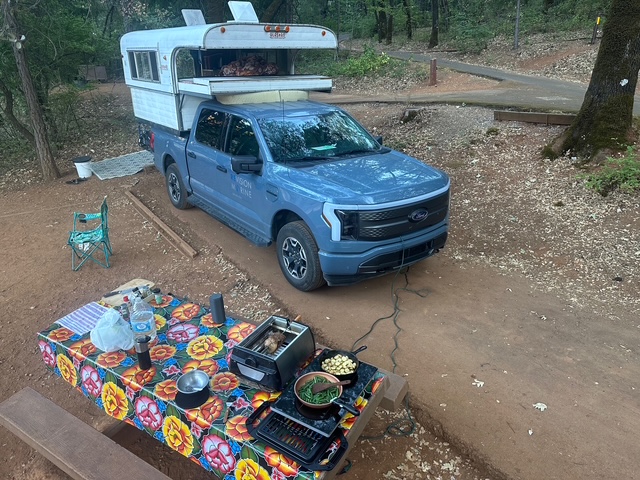
For all the engineering behind it, the camper still works the way a 1973 Alaskan should. The side-dinette layout gives Matt’s family of three a second bed that doesn’t require anyone to climb over someone else in the middle of the night. Inside, the preserved wood interior feels closer to a classic boat cabin than a modern RV—a familiar space for someone who has spent decades designing off-grid marine systems.
What makes the setup unusual is how seamlessly the old design absorbs the new technology. Vintage doors hide modern appliances. The cabin stays warm through a heat pump instead of propane. And everything—from induction cooking to lights to refrigeration—runs cleanly off the system Matt designed.
And then there’s the part nobody expects: the hot tub!
The Hot Tub
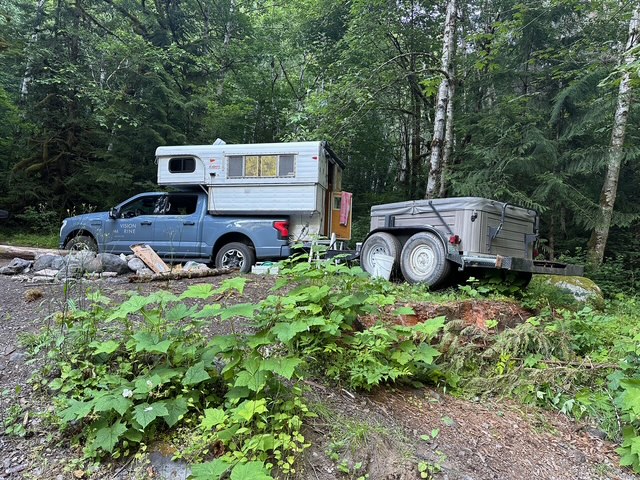
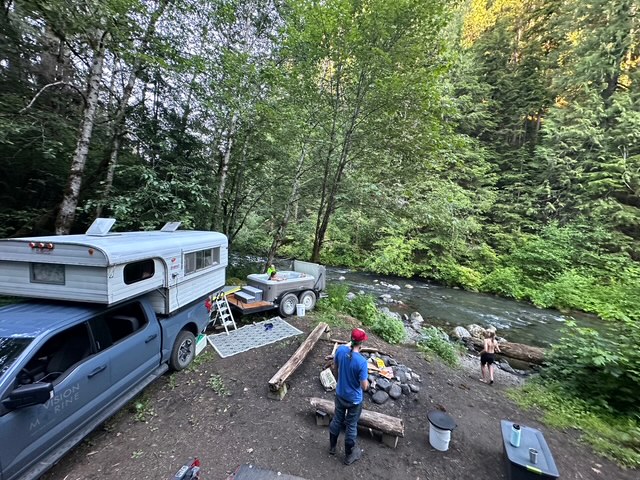
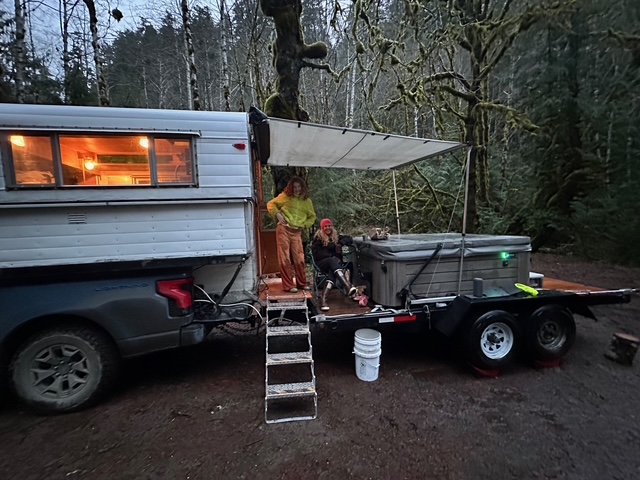
Yes, the hot tub is real. Matt hauls a three-person Hot Springs spa on a custom trailer, complete with a little deck he built to meet the back door of the Alaskan. Park the camper, drop the deck, and you’re stepping straight from a 1973 pop-up into steaming water in the middle of nowhere. (This was the moment in the interview where we quietly wondered how to become his new best friend.) He went through three trailer designs before landing on one that tows cleanly behind the Lightning and sets up fast enough to justify bringing a spa into the backcountry. And somehow, it works: a silent EV truck, a vintage hard-side camper, miles of quiet—and a hot tub running off the same clean power system as everything else. Peak Matt: technical, intentional, and exactly the kind of madness you wish you’d thought of first.