The Truth About Truck Camper Stability
February 13, 2026
What actually makes a rig feel planted on the highway and controlled on the trail
Most stability conversations drift toward parts: sway bars, airbags, heavier springs, upgraded shocks. Those can help. But they are tuning tools, not foundations. Stability is determined by geometry, weight placement, and margin long before any aftermarket hardware is installed.
When owners say a truck camper setup feels “stable,” they usually mean it feels calm. It tracks straight in crosswinds. It does not wallow through freeway on-ramps. It does not require constant micro-corrections just to hold a lane. Stability is less about dramatic moments and more about how much mental energy the rig demands over a long drive.
To understand why some combinations feel planted and others feel busy, you have to look at the physical relationships underneath the truck.

Stability starts with geometry, not accessories
Every vehicle has a center of gravity. Add a camper and you raise it. Add water, batteries, food, gear, and rooftop equipment and you raise it further. The higher that mass sits relative to the width of the truck’s stance, the more leverage it creates in turns, crosswinds, and sudden maneuvers.
Vehicle stability research, including rollover-resistance discussions from NHTSA, consistently points to the relationship between center of gravity height and track width as a core factor in lateral stability. Raise the center of gravity and you increase overturning force. Increase track width and you increase resistance to that force. The balance between those two is what you feel behind the wheel.
That is one reason lower-profile campers often feel calmer in wind. A reduced travel height lowers center of gravity and reduces side surface area. Less side area means less wind leverage. It may not sound dramatic on paper, but over 300 highway miles it shows up in how relaxed your hands feel on the wheel.
Here is a simplified view of how geometry influences feel (None of these are good or bad in isolation. They must match the load.):
| Variable | What Changes | What You Feel |
| Higher center of gravity | More leverage in turns and wind | More body roll, more steering input |
| Wider track width | Greater resistance to roll | More planted feel in crosswinds |
| Longer wheelbase | Smoother weight transfer front to rear | Less pitch and fore-aft motion |
| Shorter wheelbase | Quicker response to steering input | More agile but sometimes more reactive |

Weight placement matters as much as weight itself
Payload conversations usually stop at the number on the door sticker. That number is critical. It is specific to your truck, and as we emphasize in “How to Read a Payload Sticker,” it should never be guessed. But staying under payload is only part of the stability story.
Where the weight sits relative to the axles changes how the truck behaves.
In towing standards such as SAE J2807, restoring front axle load is treated as essential because rearward weight transfer affects steering authority and braking balance. A camper is not a trailer, but the principle overlaps. If too much mass sits behind the rear axle, the front axle can unload slightly. Steering may feel lighter or less precise. The truck may react more noticeably to wind and road inputs.
A properly matched camper keeps its center of gravity forward of the rear axle or very close to it. When that relationship is respected, steering feel remains more consistent and predictable.
Two rigs can both be “within spec” and still feel different. The difference often comes down to how the weight is distributed.
What affects weight balance in real life
- Bed length and axle position
- Camper center-of-gravity location
- Water tank placement
- Battery and gear location
- Rear overhang
This is why platform choice matters so much. Bed length does not just change parking ease. It changes how easily weight can be positioned relative to the rear axle. If you have not already read “Short Bed vs Long Bed: What You Gain, What You Give Up,” it pairs directly with this discussion.
Wheelbase and track width quietly shape long-distance comfort
Wheelbase affects stability feel in subtle but meaningful ways. A longer wheelbase increases the distance between the front and rear axles, which generally smooths out fore-aft motion over dips and expansion joints. Under sustained load, longer platforms often feel less reactive.
Track width influences lateral stability. A wider stance increases resistance to roll forces. This is one reason dual rear wheel trucks feel exceptionally planted under heavier builds. They simply have more width resisting side loads.
That does not mean everyone needs the widest or longest truck available. It means the dimensions should be appropriate for the weight and height of the camper being carried.
Why some rigs feel “busy”
When drivers describe instability, they often use terms like floaty, twitchy, or top-heavy. Underneath those impressions are usually multiple factors working together.
Here are the most common contributors:
- High center of gravity relative to truck width
More leverage in crosswinds and lane changes. - Rear-biased weight placement
Reduced front axle load and lighter steering feel. - Operating close to maximum payload
Less margin for passengers, gear shifts, or uneven loading. - Incorrect tire inflation for actual load
Increased sidewall flex, amplifying sway sensation. - Suspension tuned to compensate rather than support
Upgrades masking mismatch instead of optimizing balance.
Tires are particularly important. They are the only contact point between truck and road. Running insufficient pressure for the real scaled weight increases sidewall deflection and can exaggerate sway. Many handling complaints improve dramatically once tire load ratings and pressures are verified against actual axle weights.
If you are unsure whether your truck is operating comfortably within limits, our breakdown in “Do Truck Campers Hold Their Value?” touches on why properly matched rigs not only drive better but retain long-term appeal in the resale market. Stability and value are more connected than people assume.
Suspension upgrades can refine behavior, but they do not lower center of gravity or move mass forward. They are tools for tuning an already appropriate platform.

Wind, fatigue, and the real definition of stable
Crosswinds are often where stability differences become obvious. A taller, boxier profile presents more surface area to the wind. That increases lateral force. The driver compensates with steering input. Over time, that input becomes tiring.
A stable rig does not eliminate wind. It reduces how much correction you need to apply. A calm-feeling setup typically demonstrates:
- Predictable steering response
- Controlled body roll
- Minimal lane wander
- Reduced driver fatigue over long distances
The outcome is subtle but meaningful. You arrive less tense. The truck feels cooperative rather than demanding.
If you are planning extended off-grid trips, such as those outlined in “3 Days. No Hookups. No Problem,” stability becomes even more important. Long highway stretches loaded with water, batteries, and supplies magnify small imbalances. A well-matched rig makes those miles uneventful in the best possible way.
How Alaskan’s design influences stability
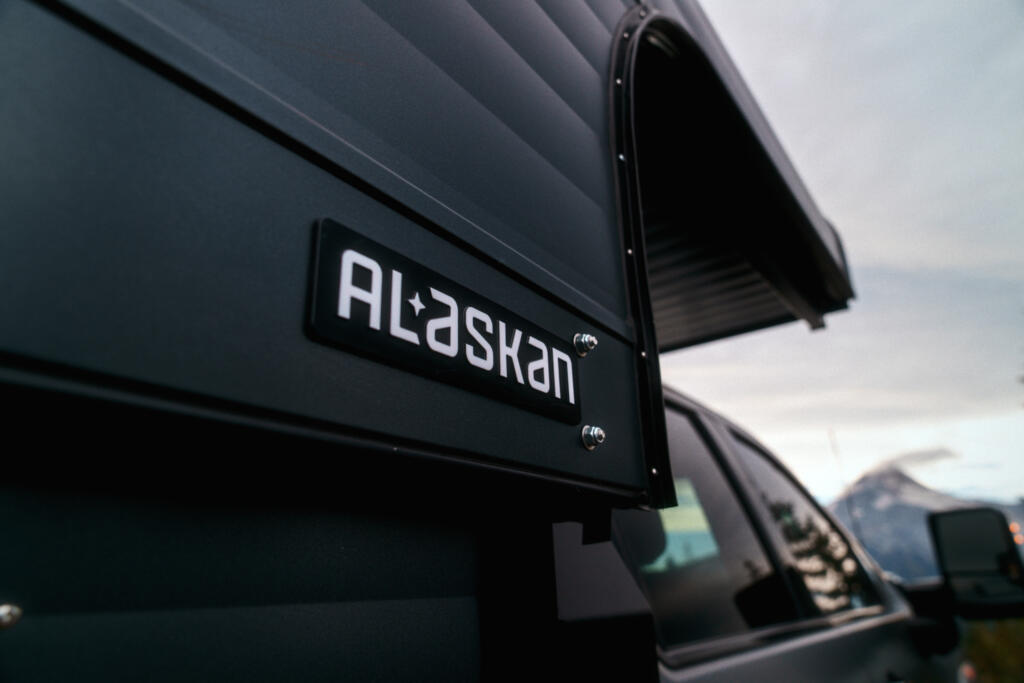
Alaskan’s hard-sided pop-up construction keeps travel height lower than many fixed hard-side campers. Lower travel height reduces side wind leverage and helps manage center of gravity relative to track width. That design choice directly affects how the truck behaves on the highway.
Just as importantly, Alaskan models are engineered around real truck dimensions and axle locations. Fitment is not abstract. Center of gravity placement and bed compatibility are treated as non-negotiable design constraints.
This philosophy connects back to platform decisions covered in “Short Bed vs Long Bed.” The camper should respect the truck’s geometry. When it does, the entire system feels calmer and more cohesive.

Stability is margin
Truck camper stability is not magic. It is the outcome of physical relationships:
- Center of gravity height relative to width
- Weight placement relative to axles
- Wheelbase length under load
- Tire capacity and inflation
- Payload margin
When those variables align, the truck feels planted and predictable. When they stack the wrong way, the rig can feel reactive even if every published rating is technically respected.
The goal is not to eliminate movement. It is to create margin. Margin reduces fatigue. Margin builds confidence. Confidence is what allows you to focus on the road and the destination instead of constantly managing the vehicle.
That is the truth about truck camper stability.