The Complete Half-Ton Truck Camper Guide
July 24, 2026
Last updated: July 2026
Can a Half-Ton Truck Carry a Truck Camper?
Yes — sometimes. A half-ton can carry a truck camper when the truck’s payload, both axle ratings, bed dimensions, and center-of-gravity zone all agree to it at the camper’s traveling weight — not its dry weight, not the number on the window sticker, the weight it hits loaded the way you’ll drive it.
We know, that’s a more annoying answer than a clean yes or no. Truck marketing has never been in the business of making this easy. 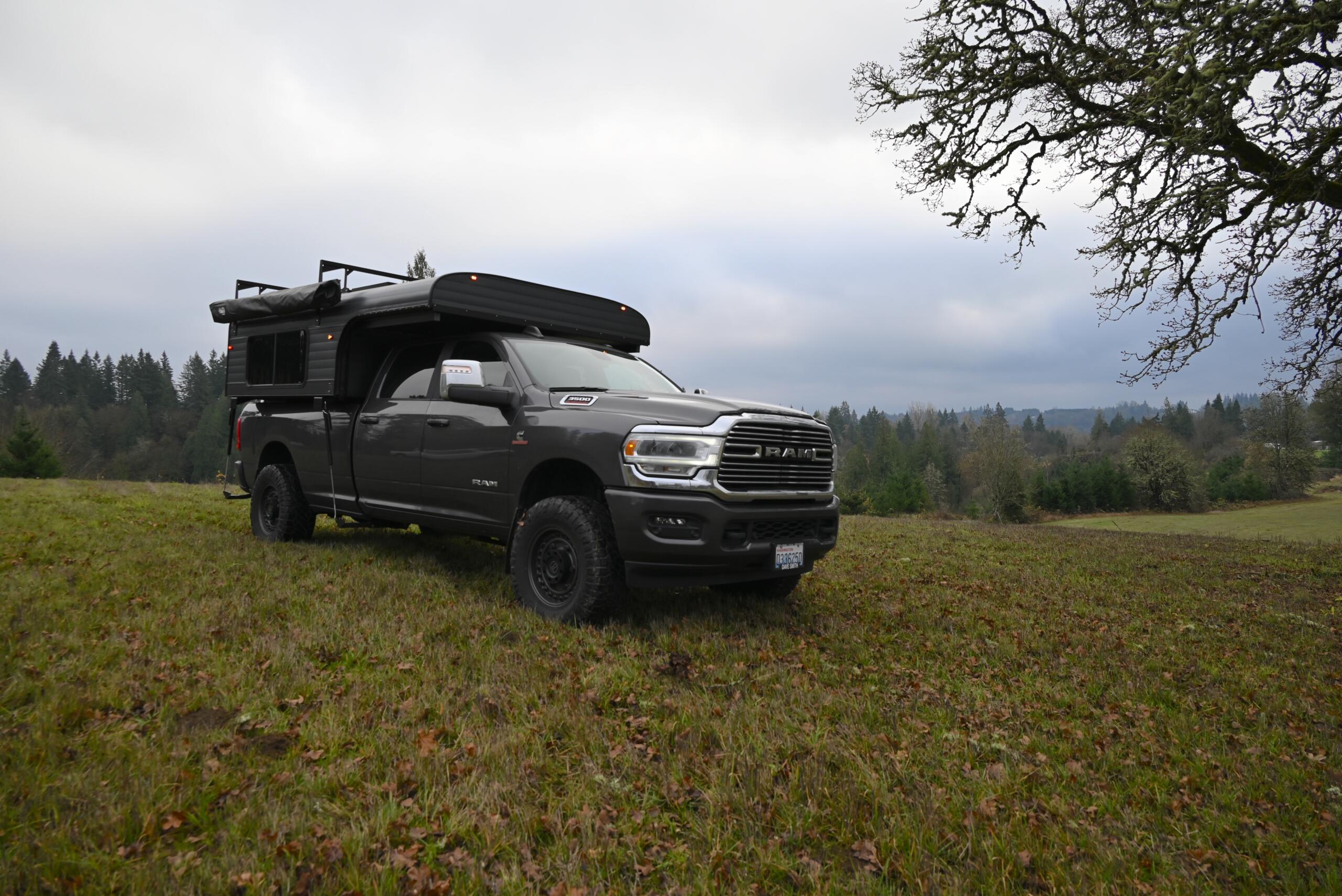
“Half-Ton” Is a Size Class, Not a Fixed Rating
“Half-ton” no longer means a truck can carry exactly 1,000 pounds. Today, it describes a class that includes the F-150, Silverado 1500, Sierra 1500, Ram 1500, and Tundra. Two trucks wearing the same badge can differ by nearly 1,000 pounds of payload depending on the cab, bed, drivetrain, engine, trim, and options.
Here are the manufacturers’ maximum published payload ratings for 2026:
- Ford F-150: Up to 2,440 pounds with the 3.5L EcoBoost V6.
- Ram 1500: Up to 2,360 pounds with the 3.6L Pentastar V6 in a Quad Cab 4×2.
- Chevrolet Silverado 1500: Up to 2,412 pounds in certain Regular Cab Long Bed configurations.
- GMC Sierra 1500: Up to 2,230 pounds in Regular Cab configurations.
- Toyota Tundra: Up to 1,850 pounds.
These are maximums for specific, properly equipped trucks. A crew cab, four-wheel drive, larger engine, off-road package, or additional equipment can reduce the payload considerably. The number that matters is the one printed on the Tire and Loading Information label inside the driver’s door.
Ready to narrow down the options? Explore our truck guides to compare payload, bed length, and Alaskan compatibility across Ford, Ram, Toyota, Chevrolet, and GMC platforms.
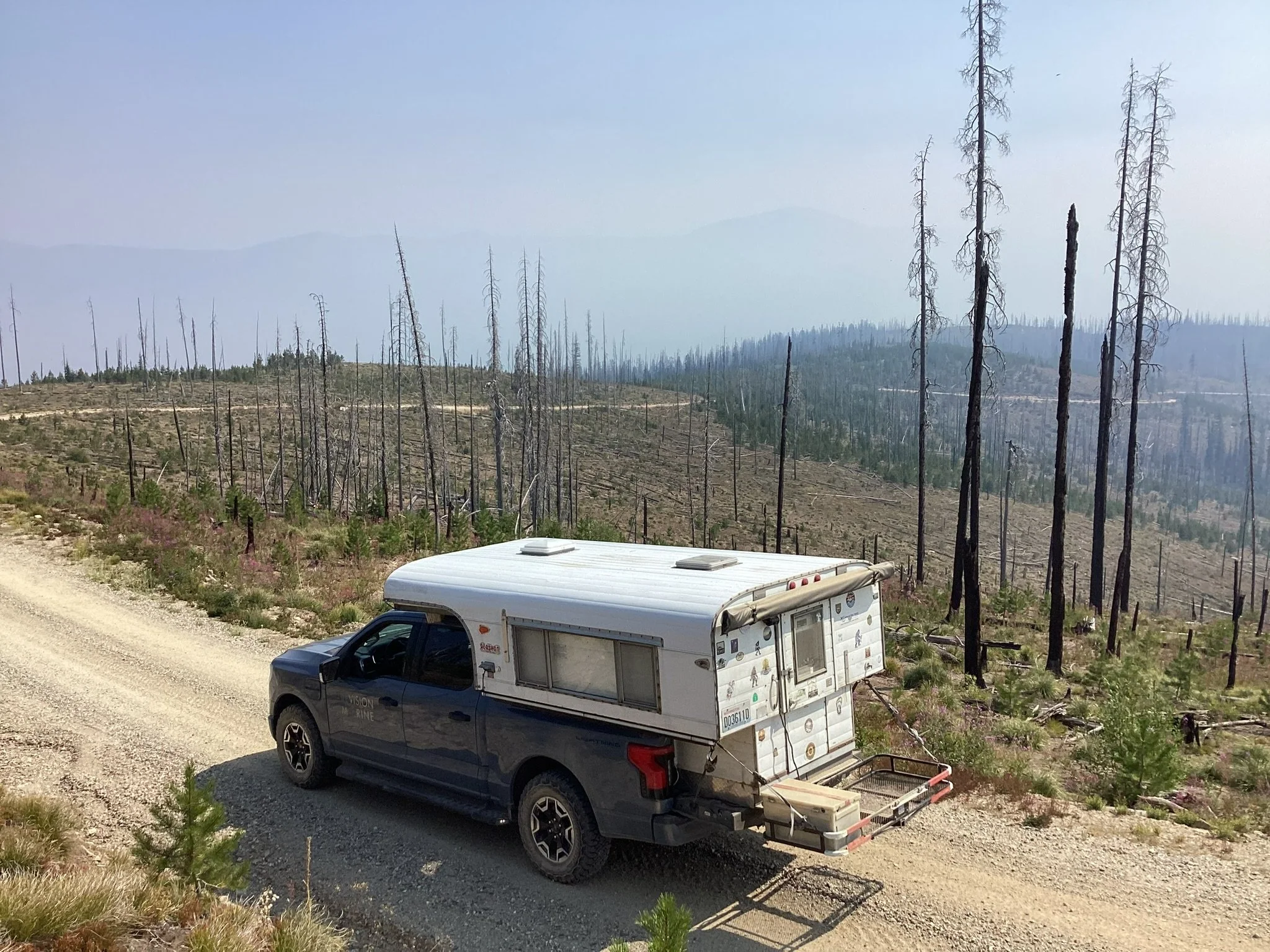
Ignore the Brochure. Find the Sticker.
The number that matters is the one on your specific truck: the Tire and Loading Information label inside the driver’s door. It says something like “the combined weight of occupants and cargo should never exceed ___ pounds.” That figure — not the marketing max — is what your camper, water, gear, passengers, and any extras all have to fit under together.
We published a complete walkthrough on how to locate and interpret it: How to Read a Payload Sticker.
The simple math that decides everything: Available payload − occupants − loaded camper weight − other cargo − trailer tongue weight = remaining capacity.
A positive number is required. A negative number ends the conversation.
Three Weights — Only One Actually Matters
| Weight Type | What It Means |
| Dry weight | Camper before water, cargo, and many options |
| Wet weight | Dry weight plus fluids (fresh water, fuel, propane) |
| Loaded weight | The camper as you will actually travel with it |
Only loaded weight decides whether this works. Water alone runs about 8.34 lbs per gallon, so a 15-gallon tank adds roughly 125 pounds before you’ve packed a sock.
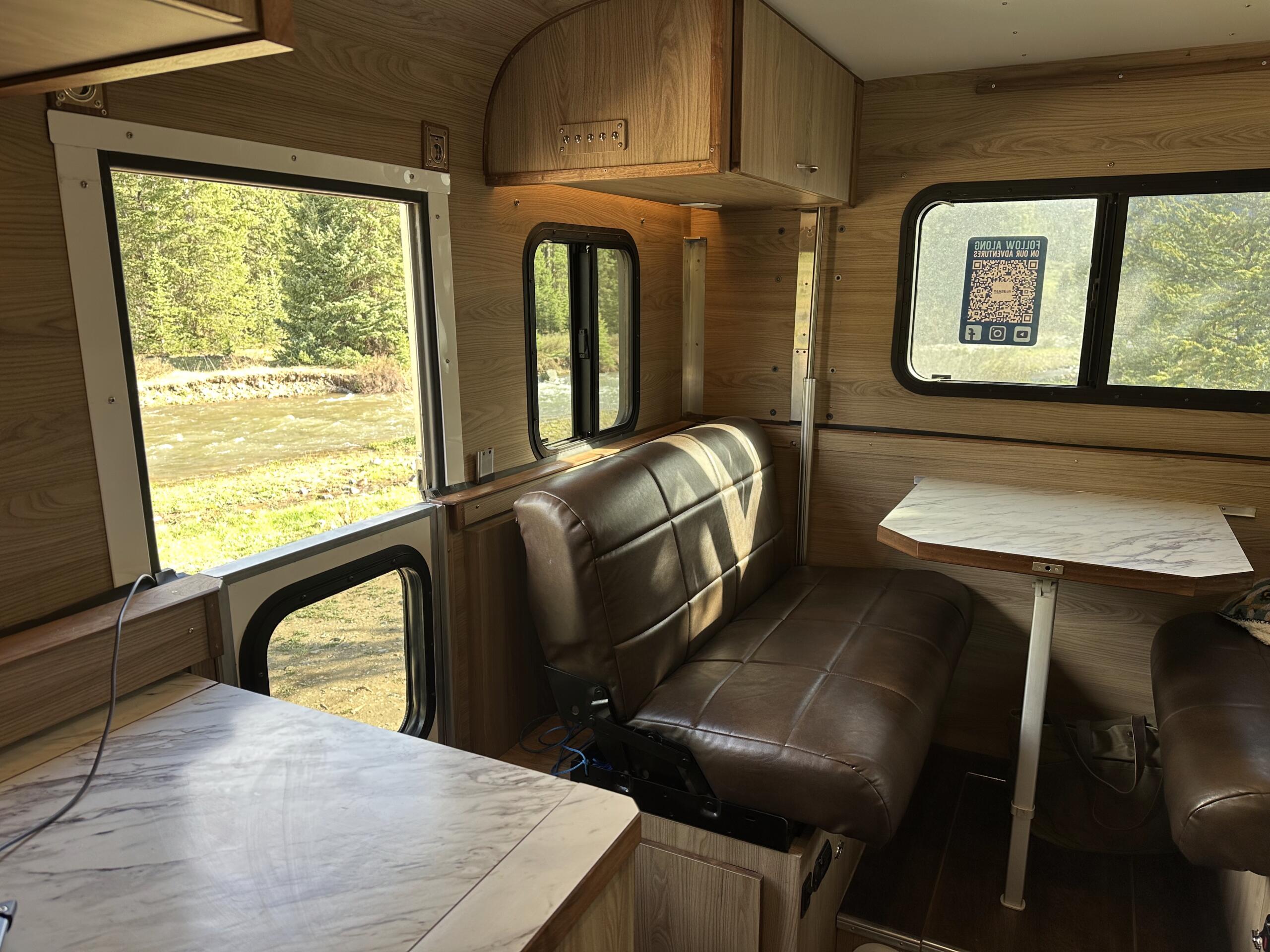
Let’s Do the Math
Hard-sided pop-up campers — the category this article is actually about — run roughly 1,700 to 2,400 lbs dry, with a handful of larger models pushing close to 3,000. That’s wide enough that the same camper category can work on one truck and be a non-starter on another. Two scenarios, both real:
Scenario one: the common mismatch. Say your door sticker allows 2,150 lbs combined for occupants and cargo — realistic for a Crew Cab half-ton in a mid-range trim.
| Item | Weight |
| Hard-sided pop-up, dry (mid-range for the class) | 1,900 lbs |
| Camper options | 100 lbs |
| 15 gallons of fresh water | 125 lbs |
| Two occupants | 350 lbs |
| Food, clothing, camp gear | 200 lbs |
| Tie-downs, bed mat, hardware | 80 lbs |
| Total | 2,755 lbs |
That’s 605 pounds over. Not a close call — a mismatch. This is the pairing most people back into by matching truck size to camper size and never checking the sticker.
Scenario two: what it takes to fit. Same camper category, lighter unit from the low end of the range, paired with a truck built for payload rather than comfort — say an F-150 in its highest-payload 4×2 configuration, at 2,440 lbs.
| Item | Weight |
| Hard-sided pop-up, dry (low end for the class) | 1,700 lbs |
| Camper options | 75 lbs |
| 10 gallons of fresh water | 83 lbs |
| Two occupants | 350 lbs |
| Food, clothing, camp gear (packed lean) | 150 lbs |
| Tie-downs, bed mat, hardware | 60 lbs |
| Total | 2,418 lbs |
Twenty-two pounds remaining. Plenty of experienced travelers run closer to the limit, and some knowingly go beyond it. That is their call, but Alaskan cannot recommend exceeding the truck manufacturer’s ratings. In this case, the bigger issue is that 22 pounds leaves no useful room for forgotten gear, firewood, or extra water. The pairing works on paper, but we would weigh the fully loaded rig before trusting it on the road.
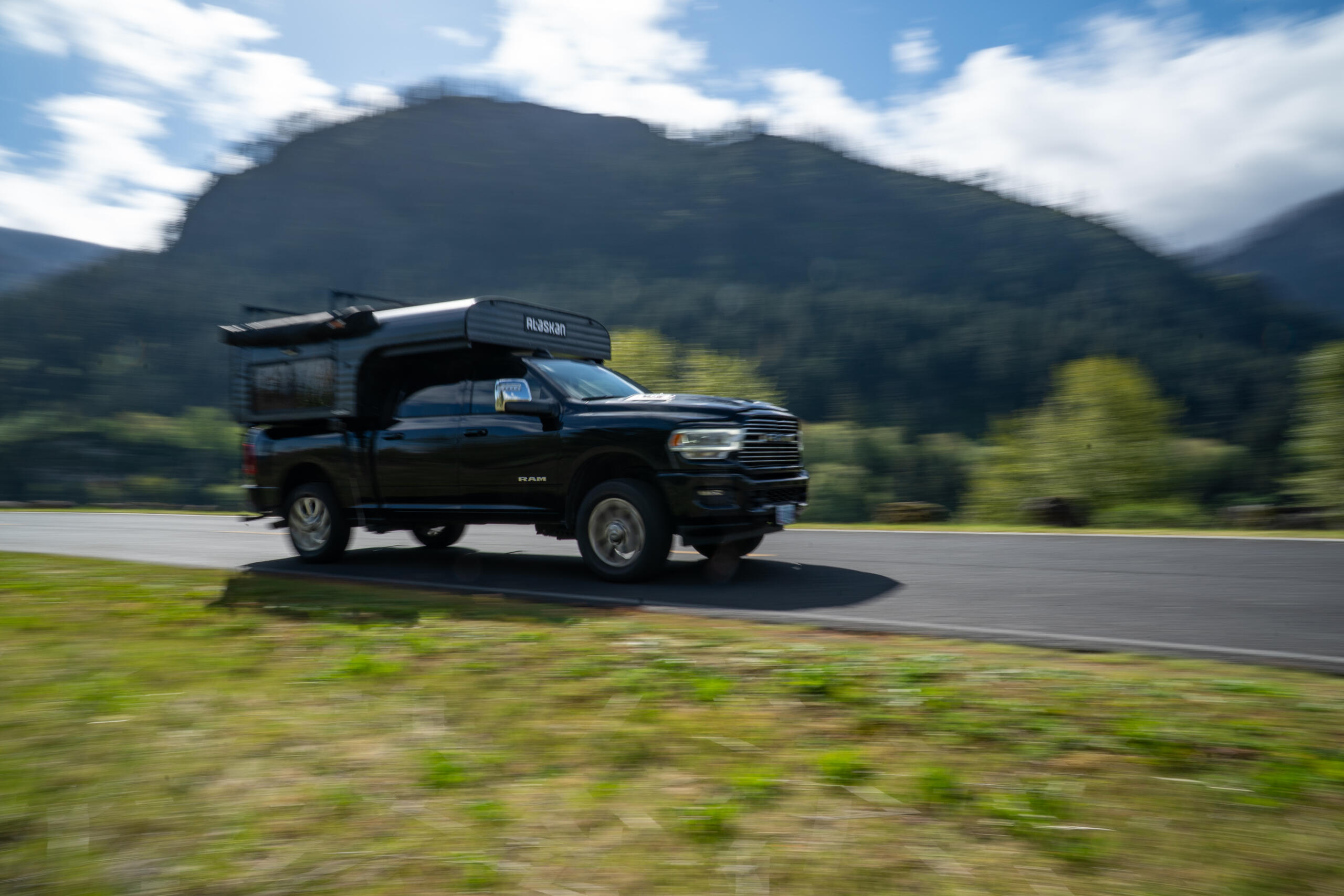
Payload Is Not the Only Limit You Can Exceed
Stay under total payload and you can still overload a single component. Four more things to check:
GVWR (Gross Vehicle Weight Rating) — the max allowed weight of the loaded truck: truck, camper, people, cargo, everything. A certified scale is the only way to know for certain.
GAWR (Gross Axle Weight Rating) — each axle has its own limit, and a camper stacks most of its weight over the rear one. You can sit well under total GVWR and still overload the rear axle specifically. A scale ticket beats a confident glance at ride height — Ford’s own RV and towing guide is direct about this: adding cargo can’t push either axle past its GAWR even while total GVWR still has room.
Tires — they need rated capacity for what’s sitting on that axle, at the cold pressure listed on your truck’s placard, not the number stamped on the tire’s sidewall. NHTSA’s tire safety guidance is built around the placard figure for exactly this reason — inflating to sidewall max doesn’t buy extra payload, it just makes the tire firmer.
Center of gravity — the camper’s center of gravity has to land inside the truck’s approved zone, usually forward of the rear axle. Miss this and you can lighten the front axle enough to hurt steering and braking, even while staying under every weight rating on paper.
Bed Fit Is Its Own Checklist
Payload doesn’t guarantee the camper fits the bed. Confirm bed length, width between wheel wells, rail height, cab-over clearance, and tailgate closure before anything else. Hard-sided pop-ups in this weight class typically run 6 to 6.5 feet, built to fit standard beds — but short beds under 6 feet are consistently the wrong call. We go deeper on this in Short Bed vs. Long Bed: What You Gain, What You Give Up.
Airbags and Helper Springs Do Not Rewrite Physics
Air springs, helper springs, upgraded shocks, a sway bar — all of these can improve how a properly loaded truck rides and handles. None of them raise your GVWR, your GAWR, or your certified payload rating by a single pound. They make a legal load feel better. They do not make an illegal load legal. Suspension upgrades refine a setup that already works — they’re not a workaround for one that doesn’t.
What Changes Once You’re Loaded
A camper adds significant mass and raises the center of gravity. Even a correctly matched half-ton will not stop, turn, or accelerate the way it does empty. Expect longer stopping distances, more body roll in lane changes, greater sensitivity to crosswinds, and more heat in the brakes and tires on long descents. Leave extra following distance, take curves slower than feels necessary, and descend grades in a lower gear than you think you need. Power makes the climb feel easy; gravity collects on the way down. For deeper handling discussion see The Truth About Truck Camper Stability.
Towing Behind the Camper?
Plenty of camper owners still want the hitch for a boat or utility trailer. Tongue weight presses straight down on the truck and counts against your payload, and a hitch extension can shrink what your receiver’s allowed to carry. Run the math for the no-trailer setup and the with-trailer setup separately — a rig that works fine solo can run out of margin the moment you hook something up.
When a Half-Ton Makes Sense
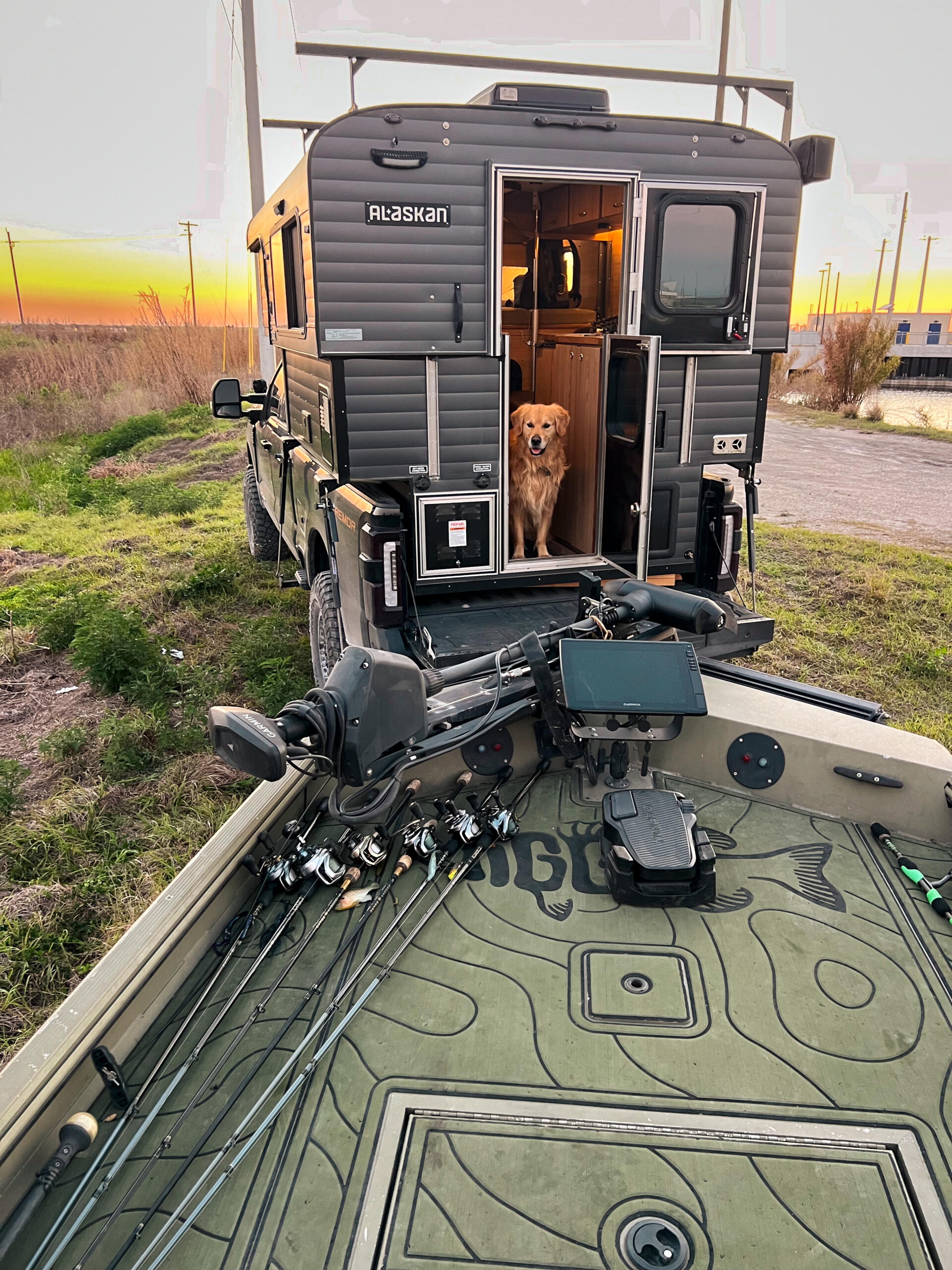
A half-ton makes sense when the specific truck has enough payload for the fully loaded camper, passengers, water, and gear. The bed fit and center-of-gravity range also need to line up, while towing should be light or absent. In return, you get a truck that is easier to drive, maneuver, and park every day, which matters when the camper is only part of its job.
When to Step Up to a ¾-Ton
Step up when the half-ton math is already tight before you’ve packed anything, when several people travel regularly, when you want real water or battery capacity, when you’re hauling meaningful gear, or when you plan to tow. The extra capacity buys a better ownership experience, not just a safer spreadsheet — constantly rationing water and gear to preserve a half-ton pairing can undercut the reason you bought a self-contained camper in the first place.
| Truck Class | Typical Payload | Best-Suited Camper | Trade-Off |
| ½-Ton (1500-series) | 1,700–2,500 lbs | Pop-ups, minimal hard-sides (HS 640) | Best economy & maneuverability, least margin |
| ¾-Ton (2500-series) | 3,000–4,500 lbs | Most hard-sided Alaskans | Real cushion, more truck to manage |
| 1-Ton (3500-series) | 5,000–7,500 lbs | Full off-grid builds | Max capability, bulkiest, thirstiest |
Where Alaskan Fits
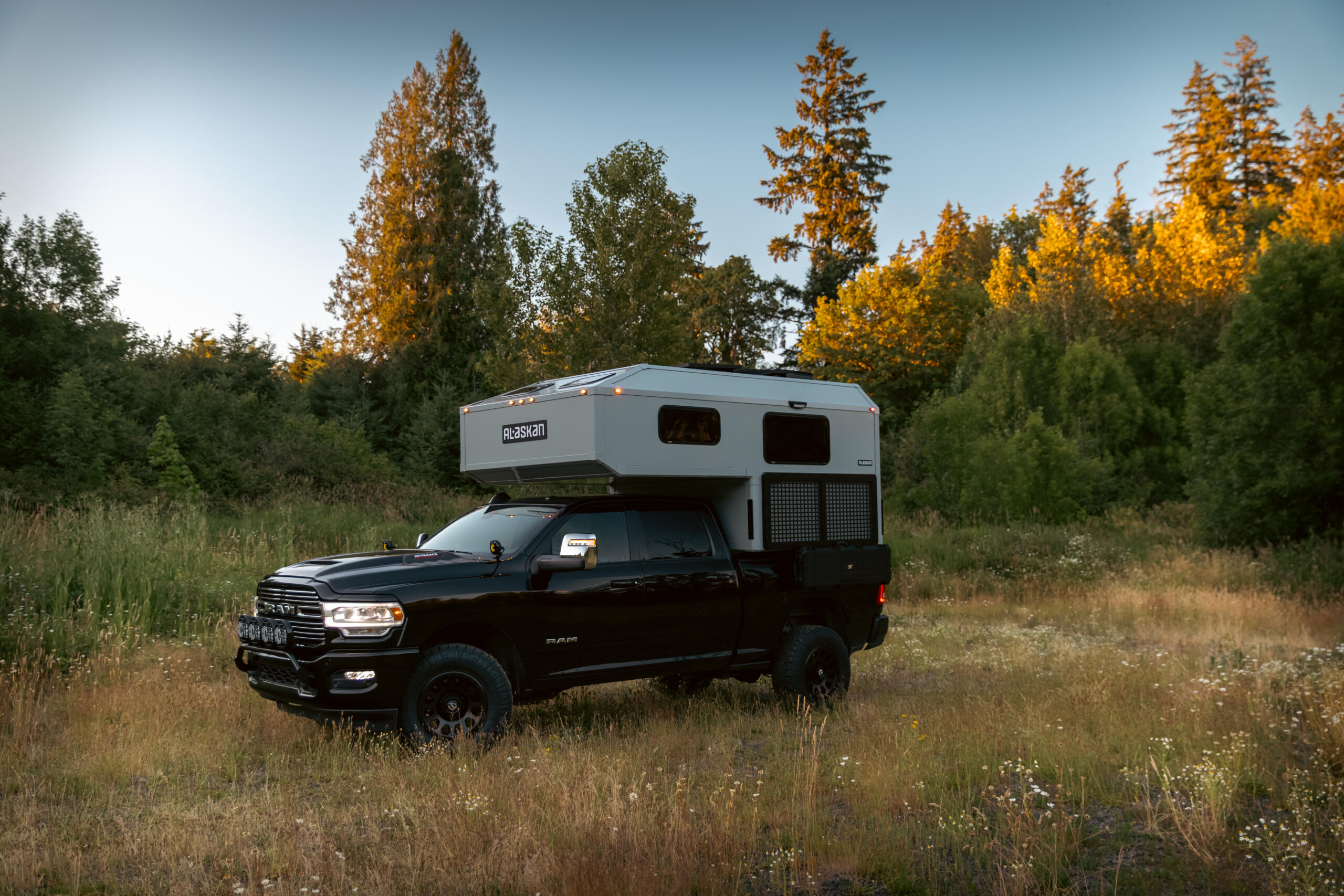
Our traditional hard-sided pop-ups generally prefer a ¾-ton or larger — that’s mostly physics. Those models typically run 1,700 to 2,400 lbs dry depending on length and options, which puts only the lighter end within realistic reach of higher-payload half-tons (certain F-150 builds, some Regular Cab Silverados, etc.).
The HS 640 changes the picture. It’s a fixed hard-side (not a pop-up) designed from the ground up to be lighter — starting at approximately 1,500 lbs dry — specifically to open more half-ton pairings than previous Alaskan hard-sides. It doesn’t make every half-ton a good match. It does make a proper pairing possible on trucks that are actually built for payload, provided you’re honest about the loadout. A leaner regular or quad cab often has real potential. A fully loaded crew cab with every option checked usually has less room to work with. Match the specific truck to the specific sticker.
Ten Steps Before You Buy Either Half of This Rig
- Read the payload sticker on the actual truck, not the maximum in the brochure.
- Check the owner’s manual and vehicle-specific camper information for slide-in camper guidance, required equipment, and any factory camper package.
- Record the GVWR and front and rear GAWRs from the truck’s certification label.
- Get the camper’s as-built weight with every factory and dealer-installed option included.
- Add a realistic travel load: passengers, water, propane, batteries, tie-downs, bed mat, food, tools, and gear.
- Confirm that the camper’s center of gravity falls within the truck manufacturer’s recommended range.
- Measure the bed, including its length, width between the wheel wells, rail height, cab clearance, and tailgate requirements.
- Verify that the tires can carry the expected axle loads and follow the vehicle manufacturer’s recommended cold inflation pressures.
- If towing, include tongue weight and hitch hardware in the payload calculation, then check GVWR, rear GAWR, GCWR, receiver, and hitch-extension ratings.
- Weigh the finished rig in normal travel trim, including the total truck and each axle. If any rating is exceeded, a comfortable lap around the block does not make the numbers disappear.

Frequently Asked Questions
Can a half-ton truck carry a hard-side truck camper?
Sometimes, and only within a tighter margin than most buyers expect. Lightweight pop-ups fit comfortably on most half-tons. A conventional full hard-side typically needs 3,000+ lbs of payload. The Alaskan HS 640 is the notable exception built specifically to close that gap for many half-ton configurations.
Can a 2026 F-150, Silverado 1500, Sierra 1500, or Ram 1500 carry a truck camper?
Certain configurations of each can, depending on the exact payload, bed size, and equipment. Payload can swing by nearly 1,000 lbs across trims of the same model, so the model name alone tells you almost nothing. Always check the specific truck’s door sticker.
What is a safe payload margin?
Stay 10–15% under your rated payload rather than right at the limit. That cushion accounts for scale variance and the gear that inevitably multiplies between the garage and the campsite.
Do airbags or helper springs increase payload capacity?
No. They improve ride and reduce sag on an already-legal load. They do not change GVWR, GAWR, or certified payload by a pound.
Does water count against payload?
Yes. Every gallon is cargo. Fifteen gallons is roughly 125 lbs before anything else is added.
Is a ¾-ton always the better choice?
Not always, but it is the more forgiving one. A well-matched half-ton with a light camper such as the HS 640 can work genuinely well. A ¾-ton buys flexibility for passengers, water, gear, and towing that a half-ton build must constantly negotiate around.

The Bottom Line
A half-ton can carry a truck camper when the labels, the scale, and the actual loaded weight all agree with each other — not when a forum thread or a brochure agrees with you. Read your sticker, do the math honestly, check both axles and the tires, confirm the physical fit, then weigh the finished rig. It is a less glamorous process than picking floorplans and exterior colors. It is also the difference between the first drive feeling like the start of a trip and feeling like a live physics demonstration you did not sign up for.
Related Reading
How to Read a Payload Sticker · The Right Truck Size for an Alaskan Camper · The Truth About Truck Camper Stability · Truck Camper MPG: What You’ll Actually See at the Pump · Introducing the Alaskan HS 640
Truck Guides