
The idea that made it possible
What Irene described around that fire became the core of the design.
A camper didn’t have to stay one shape. It could ride low and controlled on the road, then lift into a full-height, hard-sided space once you stopped. At the time, most campers forced a choice between stability on the road and livability at camp. Don and Irene refused that tradeoff.
Over time, the story has been told a few different ways. Sometimes it begins with a hat box by the fire off the Alcan Highway. Other versions feature a box of matches instead, the tray sliding within its sleeve to show how something could raise and lower without losing its structure. The details shift, but the idea stays the same.
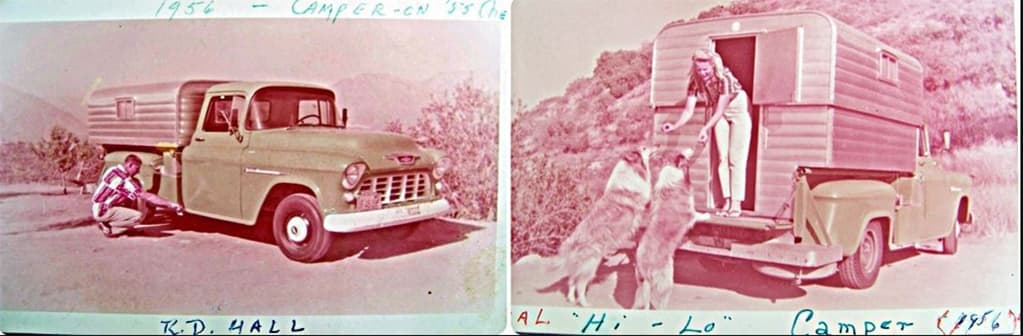
The first prototypes went straight into the kind of travel they were built for, loaded, driven, and lived in, with each trip revealing what needed to change, where the structure held, where it needed reinforcement, and what could be simplified without losing strength.
You can still see traces of that process today when early Alaskans are taken apart and restored, handwritten measurements, layout markings, and small decisions worked out in real time. A design worked out in use, not on paper.
By the time it settled into form, it had already been tested where it counted.
Two founders, one standard
Alaskan Campers didn’t come from a single point of view, and that’s part of why it worked.
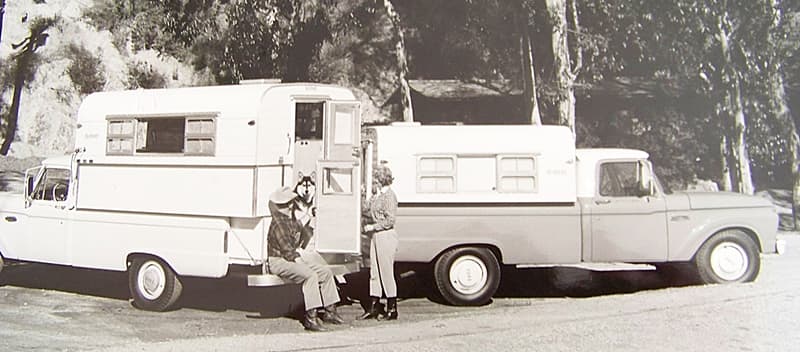
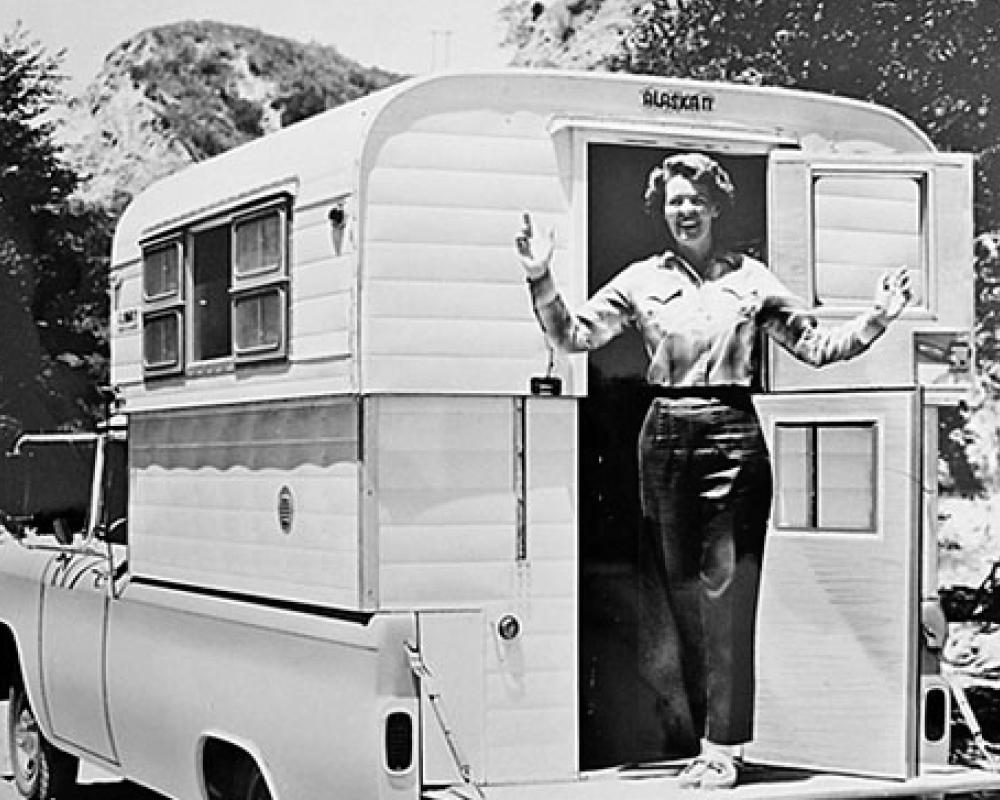
Irene’s expectations were part of the design from the start — not added later, but built in from the first question. The trip had to be livable once they arrived. Her insistence on that is what pushed the concept forward. The camper had to be two things at once because she needed it to be.
Don focused on making that possible. The structure, the lift system, the construction methods — every decision that determines whether something holds up not just on the first trip, but on the tenth, in conditions that expose weaknesses fast and leave no room for guesswork.
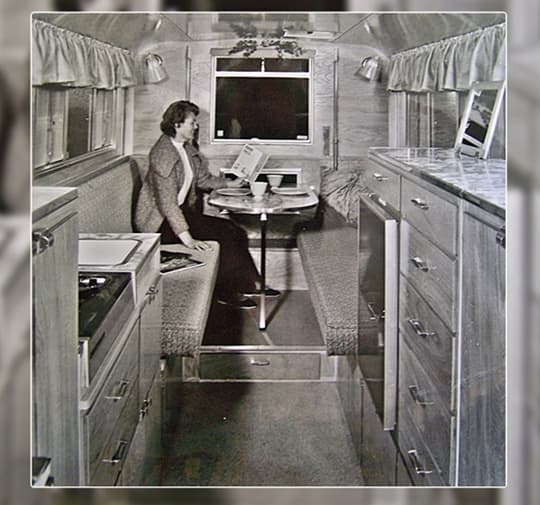
Irene made sure that structure translated into something people would actually want to live in. She shaped the interiors and how the space functioned day to day, hand-painted the Alaskan emblems, and was the face customers met at shows, answering hard questions and walking them through how it worked.
When it proved itself
They built it to travel, and that’s exactly what it did.
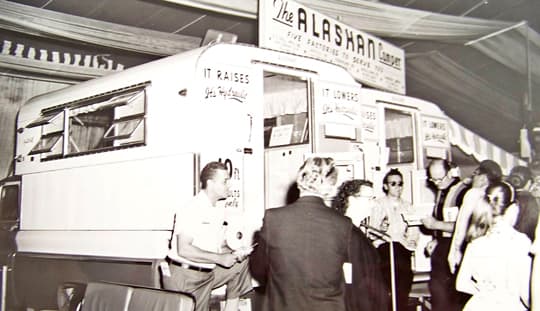
As Don and Irene put the first prototype to use, it started drawing attention. The lower profile, the way it handled, the way it fit the roads they were on, it stood out immediately. People stopped to ask about it. Then they started asking if one could be built for them. That interest changed the direction of things.
What began as a personal build turned into something others were willing to invest in. Don and Irene made the decision to go all in, mortgaging their home and committing to the idea that a camper built this way could stand on its own.
When they brought it to shows, the response only reinforced it. People saw how it worked and understood why it mattered. By 1958, Alaskan Campers was in production, backed by a patented telescoping design and a clear point of view: no tradeoff between how it drives and how it lives.
Growth, without losing the idea
Early response at shows was strong, demand followed, and the product grew. New configurations were introduced, new models followed, and by the early 1970s, production had expanded across the U.S. and Canada to keep pace.
Through that growth, the core idea held. The defining structure didn’t change because it continued to do exactly what it was built to do.
Ownership changed hands over the decades. In 1989, Don Wheat acquired the company, followed by Bryan Wheat’s leadership in the years after. Later, under John Macpherson, operations moved to Washington and the business continued to evolve.
What didn’t change was the approach: build it right, and let the product speak for itself.
That standard carried through each transition, measured the same way it always had, by whether it still worked the way it was intended to.
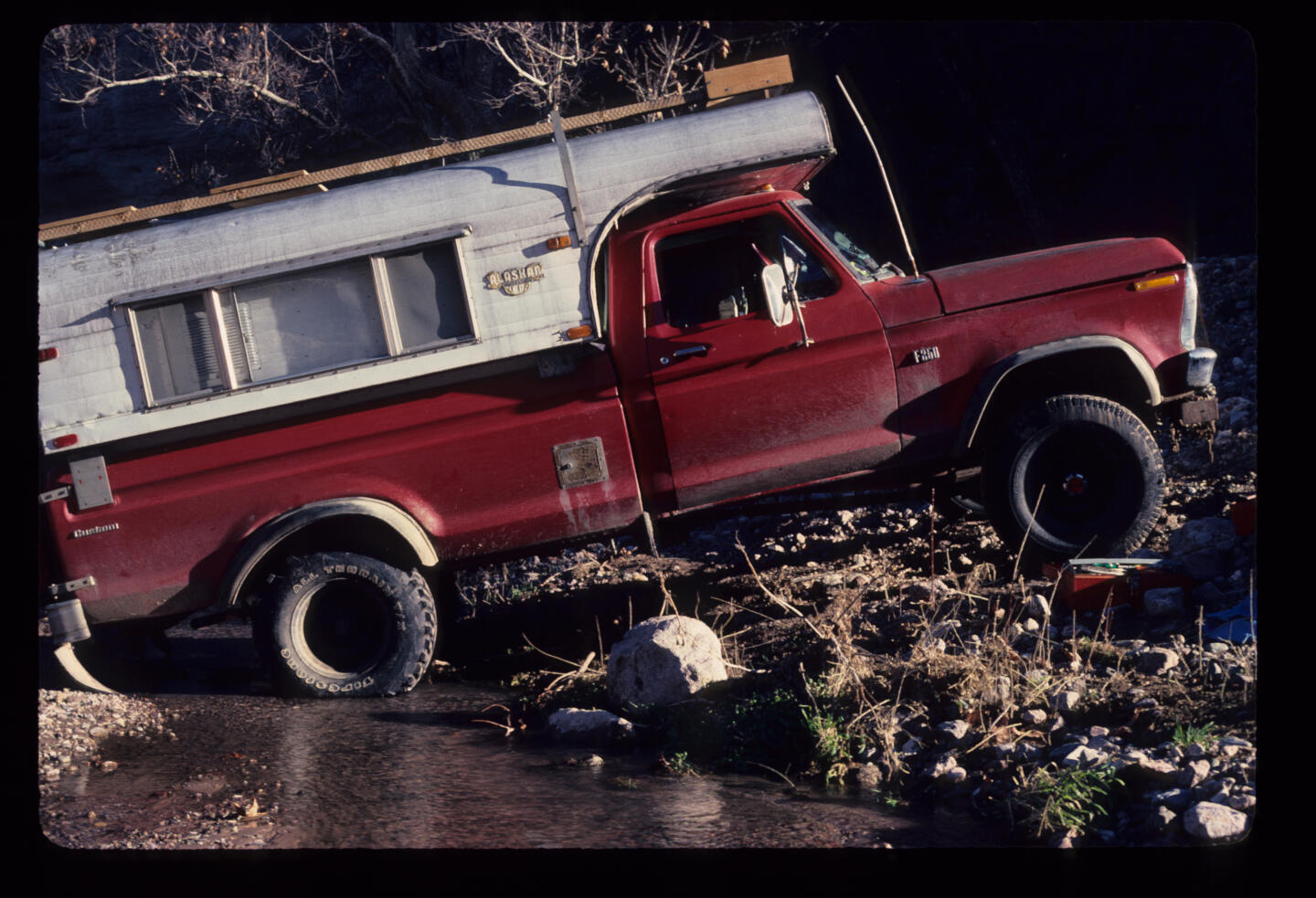
The proof is easy to find. Older Alaskans haven’t disappeared. They’re still being used, maintained, and rebuilt by owners who keep them going and on the road.

Building on the foundation
Today, Alaskan Campers operates under new Pacific Northwest ownership, led by CEO Rob Scheele and backed by an experienced team.
The approach hasn’t been to reinvent the product — because the foundation doesn’t need reinventing. The focus is on refining how it’s built and expanding what it can be, without compromising what makes it an Alaskan. Lighter builds, broader truck compatibility, more efficient materials — the same thinking that shaped the original design, applied to new constraints.
Production remains in Washington, and the campers are still built by hand. The tools behind that process have evolved. CAD systems have replaced hand-drawn plans, CNC machining improves consistency where it matters, and materials are being evaluated to reduce weight, improve efficiency, and maintain structural integrity.
The telescoping design remains part of that work, but it’s not the limit. What matters is how the camper performs, on the road, at camp, and over time. That same standard is now showing up in new ways, including lighter designs that fit a wider range of trucks and open the door to more people getting out there without giving anything up once they arrive.
That’s why it’s called an Alaskan
Don and Irene needed a camper that could hold up in that kind of country. That’s where the standard came from, not a market gap or a business plan, but a real trip and a clear expectation for what had to work. Everything that followed was built to that same measure.
The roads have changed. The trucks have changed. Expectations have gone with them. The standard hasn’t.
Build something that travels well, holds up over time, and doesn’t force a tradeoff between the road and the place you end up. Something people still rely on years later without thinking twice about it.
That’s what Don and Irene set out to do.
They built it to handle Alaska.

The roads kind of dictate what works and what doesn't.