How to Weigh Your Truck Camper and Read the Scale Ticket
October 9, 2026
Somewhere in the packing process, “just in case” becomes a department. It has a storage bin, a backup bin, and enough equipment to open a modest hardware store if camping doesn’t work out.
Useful tools deserve a place in your rig. So do recovery equipment, drinking water, and the things that make a trip comfortable. The challenge is knowing what the whole load weighs and where the truck carries it. The “just in case” department rarely submits paperwork.
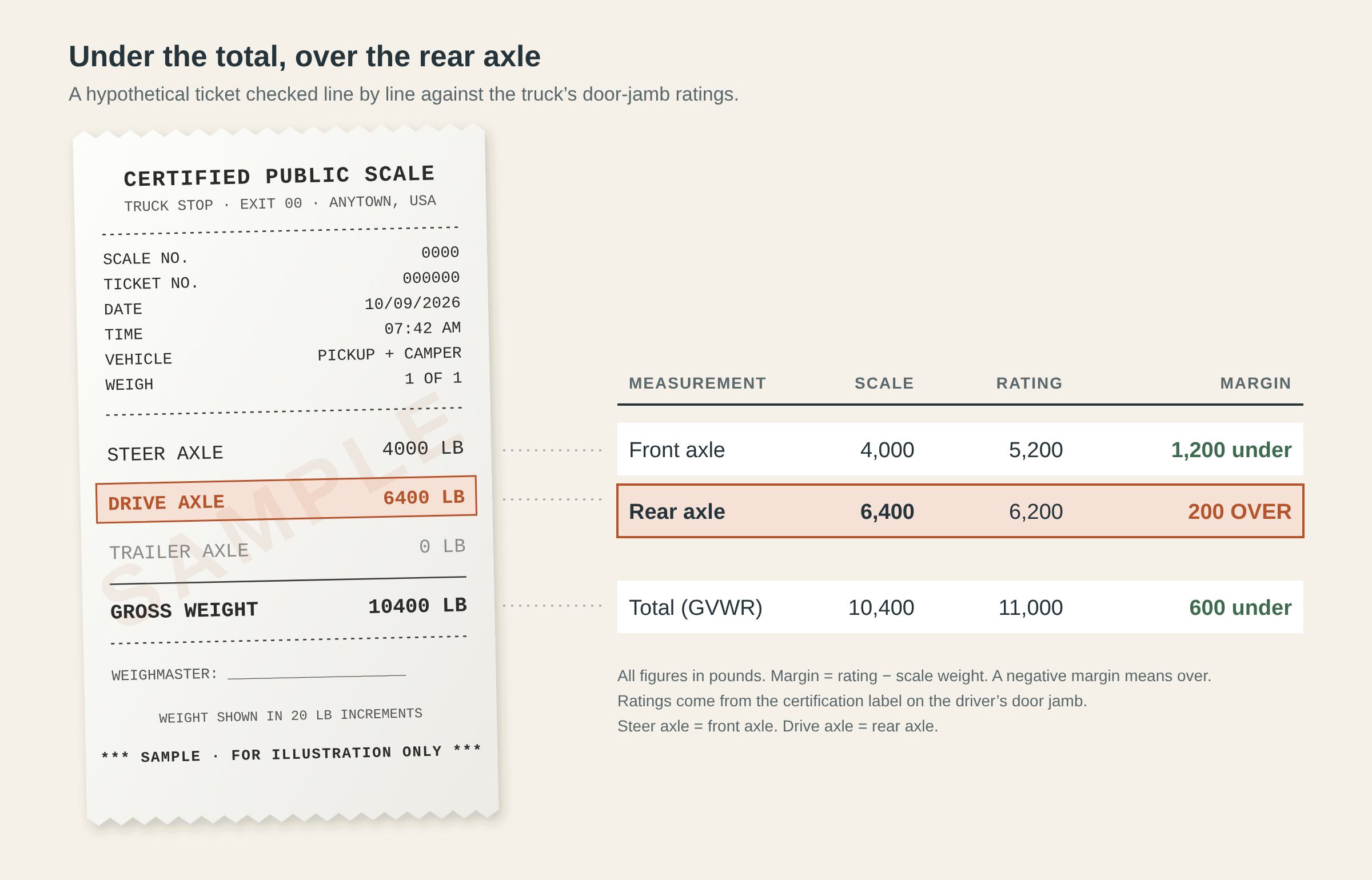
A scale ticket gives you those numbers. In our example below, the truck is 600 pounds under its total weight rating but 200 pounds over its rear axle rating. Checking only the total would miss the problem.
To weigh a truck camper, load the truck for travel, measure the front axle, rear axle, and total weight separately, then compare each reading with the corresponding rating for your truck.
Here is how to prepare, find a suitable scale, and make sense of the results.
Start With the Ratings for Your Truck
Before leaving home, photograph the truck’s certification label, usually near the driver’s door. You will need three numbers:
| Rating | Compare it with |
| GVWR: Gross Vehicle Weight Rating | Total loaded truck weight |
| Front GAWR: Gross Axle Weight Rating | Measured front axle load |
| Rear GAWR: Gross Axle Weight Rating | Measured rear axle load |
These ratings belong to your particular truck. A brochure’s maximum payload or a neighbor’s similar-looking pickup cannot supply the limits for yours.
GVWR is the maximum rated weight of the loaded vehicle. Each GAWR limits the load on that axle. Adding the axle ratings together does not create a substitute GVWR.
Also review the occupant-and-cargo limit, where provided, and the truck’s camper-loading instructions. Look for camper suitability, cargo limits, and the recommended center-of-gravity zone. Those requirements remain relevant even when the scale numbers look acceptable.
Some heavier trucks have different tire and loading labels. If yours has no occupant-and-cargo figure, consult its certification label and manufacturer documentation. NHTSA’s labeling interpretation explains why labels can differ.
For help finding and understanding the numbers, see How to Read a Payload Sticker and Truck Camper Weight Ratings Explained.

Pack for the Trip You Plan to Take
Install and secure the camper in its normal travel configuration, then load the truck as you expect to use it. Include:
- Driver, passengers, and pets.
- Fuel, fresh water, propane, and other carried fluids.
- Food, clothes, bedding, tools, and recovery equipment.
- Bikes, coolers, chairs, and other outdoor gear.
- Batteries, racks, tie-down hardware, and optional equipment.
- Truck accessories such as replacement bumpers, a winch, or storage systems.
The “just in case” bins go aboard too. Leaving them in the garage for the weighing and returning them before departure gives you a beautifully accurate measurement of a trip you aren’t taking.
Evaluate the heaviest realistic configuration you expect to carry, and record fuel and tank levels. If you normally leave with a full water tank, include that load.
Where permitted, occupants should remain aboard in their normal seats during the reading. If the operator requires them to leave, ask how to account for their missing weight. It cannot simply be added to one axle.
When estimating beforehand, check what the manufacturer’s stated camper weight includes. A dry-weight figure and a camper loading-label figure can describe different conditions, so water, propane, or equipment could already be included in one of them.
Where Can You Weigh a Truck Camper?
CAT Scale is a familiar choice, but the useful distinction is what a service can measure.
| Weighing option | Measurements to request |
| CAT or another suitable truck-stop scale | Front axle, rear axle, and total weights |
| Public or commercial vehicle scale accepting outside customers | Separate axle readings and total weight, if supported by its equipment and procedure |
| Specialized RV weighing service | Individual wheel-position loads, plus axle and total weights |
Use the CAT Scale locator or look for public vehicle scales near your route. Before visiting an unfamiliar facility, ask:
“Can you weigh a pickup carrying a camper and give me separate front and rear axle weights?”
Confirm public access, suitable equipment, certification, fees, and the operator’s procedure. A total-only reading gives you part of the answer while leaving axle loads unknown.
For individual wheel-position measurements, explore services such as RVSEF and Escapees SmartWeigh. Check truck-camper eligibility, appointments, locations, and any membership requirements.
A highway enforcement weigh station should not be assumed to offer public weighing.
How to Use the Scale
For a pickup carrying a camper without a trailer, CAT’s straight-truck instructions provide a useful example:
- Drive onto the scale slowly. The complete rig must be supported on the weighing surface.
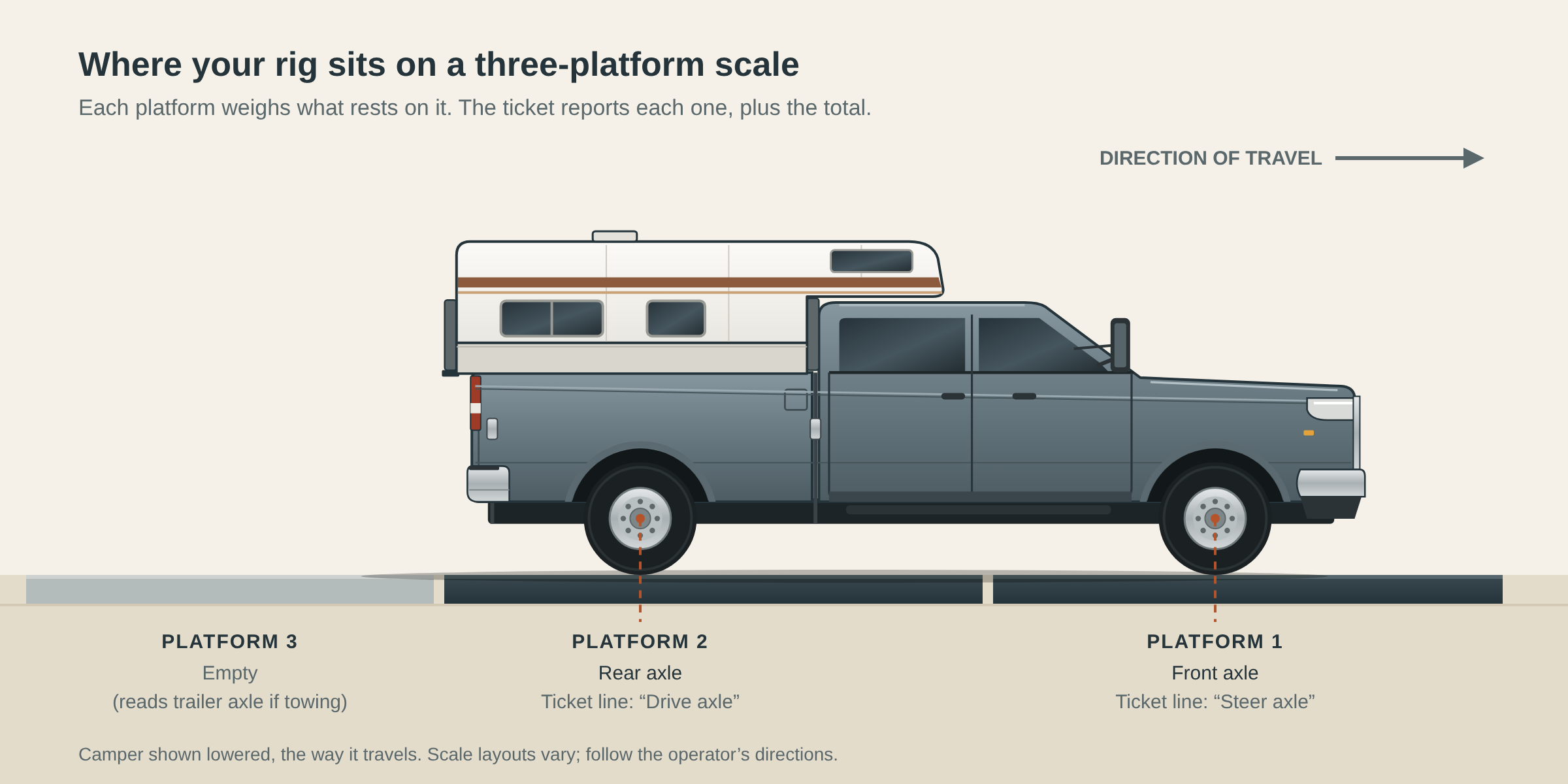
- Put the front axle on platform 1 and rear axle on platform 2. Platform 3 will normally be unused. Ask the operator if positioning is unclear.
- Request the weighing through the intercom or supported app. Provide the information requested.
- Remain still while the weight is captured. Follow the operator’s directions.
- Clear the scale and keep the ticket. Find somewhere out of the traffic flow to review it.
Other scales may have different layouts. Follow their approved procedures rather than improvising a way to separate the readings.
If using CAT’s Weigh My Truck app, set up your account beforehand. Its official help page explains location confirmation, payment, and electronic ticket delivery.
California note: The app’s PDF does not meet the additional requirements for a California Weighmaster Certificate. If you need that certificate, ask staff which ticket to obtain. The difference concerns documentation, not an inaccurate scale reading.
How to Read Your Scale Ticket
The labels may sound more suited to a freight delivery than a camping trip, but the translation is straightforward:
| CAT ticket label | Pickup with camper, no trailer |
| Steer axle | Front axle load |
| Drive axle | Rear axle load |
| Trailer axle | Normally zero or unused |
| Gross weight | Total loaded truck weight |
Compare each reading with the appropriate truck rating. Here is the example from the introduction:
These are hypothetical figures, not specifications for a particular truck or Alaskan camper.
| Measurement | Scale weight | Truck rating | Margin |
| Front axle | 4,000 lb | 5,200 lb | 1,200 lb under |
| Rear axle | 6,400 lb | 6,200 lb | 200 lb over |
| Total truck | 10,400 lb | 11,000 lb | 600 lb under |
The total looks encouraging. The rear axle result still requires a change.
Calculate the margin for each rating:
Rating − measured weight = remaining margin
For the rear axle, 6,200 minus 6,400 equals negative 200 pounds. Passing GVWR does not cancel that result, and spare capacity on the front axle cannot simply be credited to the rear.
Nor does the 600-pound total margin automatically allow another 600 pounds of gear anywhere on the truck. New cargo must also fit within axle, tire, wheel, and manufacturer loading limits. The hardware-store expansion will have to wait.
Federal truck-camper loading guidance describes this same comparison: check each axle against its GAWR and the sum against GVWR.
What to Do When a Rating Is Exceeded
Start with the specific problem rather than guessing which adjustment will help:
- Identify the exceeded limit: total weight, axle load, or a tire/wheel-position limit if individually measured.
- Remove unnecessary weight: review duplicate equipment and items that rarely serve the trips you take.
- Review placement: follow truck and camper loading instructions, including the recommended center-of-gravity zone.
- Reweigh: confirm that the revised configuration fits the relevant limits.
Moving a storage bin changes weight distribution. Leaving it home reduces total weight. Those are different adjustments, and neither should be treated as a guaranteed solution without checking the result.
Keep useful emergency and recovery equipment in the discussion. The goal is a workable travel load, not an impressive ticket obtained by leaving essentials behind. Carrying less water, for example, also changes your resupply needs.
Air springs cannot raise the truck’s weight ratings. Air Lift states that its air springs do not change GVWR, GAWR, or GCWR. A truck sitting level still needs to meet those limits.
If your normal load cannot fit, reconsider the truck-and-camper match.
If You Also Tow a Trailer
In CAT’s standard layout, trailer axles use platform 3. Gross weight then describes the combination; the sum of the truck’s front and rear readings is what you compare with truck GVWR.
Tongue load affects truck axle loading. A conventional rear-mounted hitch can increase rear axle load while reducing front axle load, so the increase at the rear is not simply equal to tongue weight.
Check GCWR, trailer ratings, and receiver and hitch-extension limits as well. Follow your truck’s towing instructions and see our weight-rating guide.
Truck Camper Weighing FAQs
Where can I weigh a truck camper?
Use a suitable truck-stop scale, public or commercial vehicle scale, or specialized RV weighing service. Confirm separate axle measurements before visiting an unfamiliar operator.
Do I need to unload the camper?
No. Leave it installed for the loaded-truck rating check. A truck-only baseline answers the separate question of how much net weight was added.
Should the water tank be full?
Include a full tank if that is how you expect to travel. Evaluate the heaviest realistic load you plan to carry and record tank levels.
Can I be under GVWR but over an axle rating?
Yes. Each axle and the total must meet their own ratings. In the example above, the total is below GVWR while the rear axle exceeds rear GAWR.
Can CAT weigh individual tires?
No. CAT supplies axle and total weights. Use an appropriate specialized service for wheel-position measurements.
What if my truck has no occupant-and-cargo placard?
Consult its certification label and manufacturer camper-loading information. Ask the truck manufacturer to clarify missing information rather than assuming a cargo allowance.
When should I weigh again?
After meaningful changes in camper, accessories, passengers, packing, or towing setup. Verify replacement tire and wheel specifications even when the rig’s weight changes very little.
Give Your Packing List Some Numbers
Keep the ticket alongside rating photos and notes about fuel, water, passengers, and cargo. That record makes later changes easier to assess.
If you are shopping, a truck-only baseline and realistic travel-load estimate can help before you have a camper to weigh. Bring your truck specifications, ratings, and available measurements to a conversation with Alaskan through Find Your Alaskan.
There is room for “just in case” in a well-planned setup. Weighing helps you decide how much room you have, before the backup bin requests a trailer of its own.